5 Science-Backed Steps to Biohack Your SleepCreated with Reflux Gourmet

Photo courtesy of Nirav Patel
As calendars fill up and summer's loose, easygoing schedule starts to slip away, fall becomes the natural moment to rebuild an evening routine around sleep-supporting science.
Sleep hygiene is your baseline: dark room, cool temperature, phone in the other room. But on its own, it only goes so far, says Kate Malcolm, MD, a sleep medicine physician at UCSF. Instead, Malcolm recommends specific, science-based steps that work with your biology to gently bring sleep on.
The goal is to find what works for you and stick with it—don’t innovate or change much day-to-day. "Sleep should be the most boring thing you do,” Malcolm says.
One more quick note: It’s possible to try too hard. Malcolm cautions that optimization can quickly tip into orthosomnia: an obsession with perfect sleep that actually degrades sleep itself. Remember that these are recommendations, not rules, and that the goal is to relax. And if sleep trackers and strict routines are starting to stress you out, don’t double down—dial it back.
A few specific, science-based strategies to try, below.
1Shut Down the Kitchen
A big meal too close to bedtime can keep you lying awake—or waking up frequently overnight. For most people, Malcolm says, three or so hours between dinner and bed is enough of a gap.
And then there’s the alcohol factor: Alcohol can actually help you fall asleep, but a nightcap ends up being a bad trade in the second half of the night, disrupting REM and prompting wakeups. Malcolm says the cleanest recommendation is to avoid alcohol entirely, but that if you do drink, earlier and less is better. Although she won’t outright tell you you can’t have your one glass of wine with dinner: “If you're eating 3 hours before bed, which you should, a glass of wine with dinner, in my opinion, is fine.”
Some people may need a longer interval between dinner and bed, including at least one in five of us because of acid reflux. Reflux is a sleep problem more than most people realize: In one survey, three-quarters of people with reflux said their symptoms disrupted their sleep, and 40 percent said nighttime heartburn left them off functioning worse the next day.
The problem is less about being asleep than it is lying down: “Gravity is a wonderful reflux remedy,” says Peter Belafsky, MD, an ENT-otolaryngologist and cofounder of Reflux Gourmet. When you’re upright, the contents of your stomach have to travel uphill to do any damage. But lying down, it’s easier for it to slip into your esophagus and even the throat—and sit there for minutes to even hours. (Speaking of gravity: Belafsky suggests sleeping on your left side using a seven-inch wedge—not pillows—to elevate the upper body and minimize nighttime reflux.)
The first remedy, Belafsky says, is meal timing: Those with reflux should factor in more time—four to five hours at least—to allow their stomach to empty before they go horizontal. An after-dinner walk can help that process go faster. "People call it a fart walk," he says. His wife has vetoed the name: "She makes us call it a heart walk instead; we get to hold hands."
2Sip Something Soothing
A fine exception to the kitchen closure: A sleep-supporting drink.
Chamomile has some evidence behind it for sleep quality; milk is rich in tryptophan and has been linked to better sleep efficiency (although Malcolm doesn’t recommend it to everyone—if it makes you congested, best to avoid before bed). And while there isn’t strong trial data for sleep, many of her patients do well on magnesium glycinate, which supports muscle relaxation.
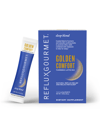
Belafsky’s company, Reflux Gourmet, makes a line of turmeric latte blends packed with alginate and herbal ingredients known to be anti-inflammatory and antioxidant, including one made for those who tend to get reflux overnight. The Golden Comfort Sleep Blend folds melatonin, L-theanine, and GABA into a warm, soothing ritual—supporting both reflux relief and a good night’s sleep in the moments where many people need them most.
(Reflux Gourmet’s Golden Comfort line also includes two additional blends: The Focus Blend is best for morning, with functional mushrooms to support cognitive function, clarity, and energy. And the Naked Blend, which is the base formula for the Focus and Sleep Blends, is great for any time of day.)
3Warm Up Your Body
Malcolm says that while an evening bath is old advice, it works, and it’s not just about relaxation: Soaking in warm water pulls blood toward the surface of your skin, and once you get out, that heat escapes primarily through your hands and feet. Your core temperature falls, and that change cues your brain to make its own melatonin—at just the right time to signal sleep.
The method is flexible. A heating mat or sauna blanket would work the same way. (“Anything that heats you up to then cool you down,” Malcolm says.) It’s the timing that matters more. Ninety minutes to two hours before bed is ideal. (Do this right before you go to sleep, and you’ll still be running warm when your body needs to be chilling out.)
4Offload Your Worries
If your to-do list sits quiet until you’re in bed and staring at the back of your eyelids, get in the habit of getting it out of your head and down on paper. Malcolm actually prescribes this to her patients: "It's called constructive worry, or cognitive offloading," she says. "You set aside time where you write down all the things you have to do or all the things you're going to worry about."
It’s great for your anxieties, but it works for other ruminations, too. Like if you find yourself rehearsing what you’re totally going to say to that one guy, or if you have a late-night idea of how to solve a problem at work. Trying to hold it in your head to deal with in the morning isn’t likely to work, and it’s almost certainly not going to help you sleep.
(And if lights are already out when this all comes on? Turn them back on, write it down, and go back to bed with the comfort that it’ll all be there in the morning.)
5Settle Your Brain
Popping in some earplugs might already be your wind-down routine’s last act—but sleep’s relationship with sound can actually begin earlier, while you’re still awake.
If you’ve never tried binaural beats, let us get you on board: It feels like effortless meditation. You put on a pair of headphones and play a track with two slightly different tones, one in each ear, and your brain fills in a third rhythm that doesn’t otherwise exist. The theory is that the phantom rhythm nudges your brain toward delta frequencies—the same brain waves involved in sleep.
You can use regular headphones for this, and you can find binaural beats tracks on most streaming services, including Spotify. But if you’d like to continue listening as you fall asleep, a binaural-beats bone-conduction headband is more comfortable. The one from SoundHealth has been studied by Stanford scientists and builds a custom session for you, and the early research is promising, if small. Malcolm isn't prescribing it yet, but she’s paying attention: "It’s a cool, new, interesting device to quiet your mind," she says.
If you find yourself looking for something that integrates a little more naturally into an evening, music can be helpful, too, although the research points to a fairly specific recipe: somewhere around 60 to 80 beats per minute—roughly the rate of a resting heart—with no lyrics, since words wake up the part of your brain that handles language.