Peptide Stacking Is Everywhere—But Should You Be Doing It?

In 2021, Jill Eisenstadt-Chayet had reached a breaking point. “I was sweating as if I was in a sauna all day long and felt like someone dropped a match down my throat,” she says of her perimenopause symptoms. She tried hormone replacement therapy and strength training, which she says helped stabilize her sleep, hot flashes, and weight. But the brain fog and skin laxity lingered.
That’s when she turned to peptides. Working with cosmetic dermatologist Ava Shamban, MD, she began a protocol that included GHK-Cu, CJC-1295, and ipamorelin to promote lean muscle mass, collagen production, and tissue regeneration. After just 60 days, she noticed a shift. “I could work out harder, lift more, and recover faster without soreness and pain,” she says. “I was suddenly feeling and looking so good, I became somewhat obsessed.”
What she’s describing is known as peptide stacking, the practice of combining multiple peptides to amplify specific outcomes, from muscle and metabolism to skin and recovery. Long a niche fixation in biohacking circles, this form of peptide therapy is now moving into a more conventional lane, showing up in functional medicine offices and aesthetic clinics alike.
But as stacking moves from online forums into exam rooms, the question remains: Is this the next evolution of regenerative medicine or simply another wellness trend outrunning the research?
What Is Peptide Stacking?
“Peptide stacking refers to the simultaneous use of multiple therapeutic peptides to achieve synergistic or complementary effects,” says Mike Herring, MD, a double-board-certified internal medicine doctor, noting that the terminology itself stems more from biohacking discourse than formal clinical frameworks. “[Peptide] users typically seek tissue repair and regeneration, enhanced recovery from musculoskeletal injuries, improved body composition through growth hormone modulation, anti-aging effects, and athletic performance enhancement,” he says. "However, it’s important to note that these outcomes are theoretical and based only on limited, early-stage research or research designed for different patient populations."
Anti-aging and regenerative medicine doctor, Neil Paulvin, DO, employs peptide stacking in his practice primarily to support gut health, cognitive function, and inflammation management. “The way I explain [it] to patients is: It's either using several peptides in the same category to have a bigger benefit than using peptides individually, or using multiple peptides to hit different buttons of the same big target to amplify the effects.”
In other words: Stacking can either intensify one pathway, or address several at once.
Commonly Prescribed Peptide Stacks
Within longevity and performance communities, certain combinations have gained a lot of attention—though many peptides are pending further clinical trials and research regarding efficacy. For instance, while there are some FDA-approved, peptide-based medications (like Ozempic and Wegovy), they are distinct from the unregulated peptides that are often used in stacking protocols.
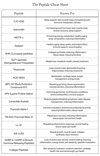
One of the most popular peptide stacks is BPC-157 and TB-500 (dubbed the “Wolverine Stack”), which has garnered attention for its regenerative and recovery-focused claims. Then there are combinations like CJC-1295 and Ipamorelin, thought to support growth hormone signaling and improve sleep quality.
According to Philip Goglia, PhD, a certified nutritionist and founder of Performance Fitness Concepts, stacks are often grouped by goal. Here are a few more common combinations:
- Longevity-focused: CJC-1295 + Ipamorelin + MOTS-c
- Inflammation management: BPC-157 + TB-500 + Thymosin Alpha-1
- Gut support: BPC-157 + KPV
- Fat loss/metabolic optimization: GLP-1 agonist + GH secretagogue + AOD-9604
- Muscle repair and growth: CJC-1295 + Ipamorelin + IGF-1 LR3 + BPC-157
Still, protocols vary widely depending on provider philosophy and patient goals. While Babak Azizzadeh, MD, FACS, a dual board-certified facial plastic and reconstructive surgeon, does not currently use these stacks in his practice, he acknowledges intrigue around preclinical findings. “Peptides are signaling molecules. So the concept is, okay, how do we biohack the system? Maybe we use BPC at this point, and then use TB-500 at a different time, and GHK at a different time, and so forth,” he says. “But we don't have really great clinical trials to prove this yet.”
Peptide Stacking in Aesthetic Medicine
Peptides have also entered aesthetic medicine—particularly in perioperative care.
“A lot of my patients are using [peptides], either perioperatively, around the time of surgery and more interestingly, post operatively after surgery,” says Sean Alemi, MD, FACS, a double board-certified plastic surgeon and ENT.
Although Alemi does not prescribe peptides directly in his practice, he has observed promising recovery narratives among patients. “[The idea] is that using peptides may improve or fortify the healing process, to supercharge recovery,” he explains, although these observations have not been confirmed in controlled clinical studies.
Copper peptides (GHK-Cu) have been well-studied and are commonly used in aesthetics settings. Also known as carrier peptides, they’re naturally occurring protein fragments bound to copper ions, and support the body’s natural repair processes. They do this by stimulating collagen and elastin production, enhancing tissue healing, improving firmness, and helping reduce the appearance of fine lines. “What we think [copper peptides] do is that they really help improve collagen synthesis and improve the integrity of the skin in the face and body,” Alemi says.
Board-certified dermatologist and surgeon Anetta Reszko, MD, has embraced peptide protocols more directly, using combinations such as GHK-Cu, BPC-157, and TB-500 to support tissue repair and reduce inflammation before and after procedures. “We actually start [peptide stacking treatment] before the procedures like lasers and microneedling, just to kind of maximize their effects,” she says. “We start using [them] a few days before the procedure, so all the cellular pathways are initiated in the body before we actually do the procedure.” This preventative protocol, she says, helps expedite healing and boosts the effects of the treatments.
Peptides and GLP-1 Weight Loss
Shamban notes that peptide stacking has also become part of the conversation for patients using GLP-1 medications for weight loss. “It’s widely known that with more rapid or more extreme weight loss comes skin laxity. Plus, GLP-1's have some association with muscle loss,” she says.
While she emphasizes that stacking peptides is not “a miracle in a syringe,” she explains that providers may combine additional peptides alongside GLP-1 agonists in hopes of supporting muscle preservation and skin firmness. “The idea is to enhance metabolism while supporting growth hormone release, and add in tissue repair to help with weight loss, building muscle, and tissue recovery as a trifecta,” she says.
Still, Shamban stresses that peptides cannot replace fundamentals like sleep, strength training, or balanced nutrition. Think of peptide therapy as a supplement to a healthy lifestyle, not a shortcut or quick-fix hack.
The Risks and Unknowns of Injectable Peptide Therapy
Despite growing enthusiasm, clinical data on stacking protocols remains limited. Most peptide combinations used for anti-aging or performance purposes are not FDA-approved for those specific indications.
“Critical research gaps include appropriate dosing regimens, optimal treatment duration, safety profiles with long-term use, actual efficacy in human subjects, drug-drug interactions when peptides are combined, and comparative effectiveness versus standard treatments,” says Herring.
Azizzadeh remains cautiously optimistic, drawing a parallel to GLP-1 drugs. “Five years from now, we may be all doing it,” he says. “Six years ago, the concept of GLP-1s was so foreign to everybody until there were large clinical trials with them, and now they’re everywhere.”
Still, some physicians embrace the modality despite the lack of human studies. According to Paulvin, absence of studies or an FDA-approval doesn’t necessarily mean there is a huge risk for most patients. (Although, it does mean that safety and efficacy haven't been established.) For now, peptide stacking occupies a space between emerging science and aspirational optimization—intriguing, mechanistically plausible, but not yet universally validated.