I Thought Osteoporosis Was an Old-Lady Problem. I Was 51 When I Found Out I Had It.

I thought I'd sailed through menopause. No hot flashes. No night sweats. No “meno belly.” I could sleep through a brass band. My period had packed its bags and peaced out at least two years ago.
Then I went in for what I assumed was a routine scan and was told I had osteoporosis.
Full-blown. I was 51.
Nothing in my limited understanding of menopause had prepared me for this. No medical professional had ever mentioned perimenopause or menopause to me, let alone mapped out what to expect on the hormonal road that follows your childbearing years. We Gen X women are navigating menopause without a roadmap—a generation of guinea pigs forced to piece it together in real time. Which makes sense, given we are the daughters of Baby Boomers, for whom the M-word was unutterable.
Menopause may be having a cultural moment, but we're still largely in the dark about the full spectrum of symptoms.
Bone loss is one of them.
While I didn’t even realize I was in menopause, I’d been dealing with bouts of anxiety I couldn’t quite explain—intense, physical, and new. I blamed work. And the divorce that had put me on my knees. My doctor did, too. After a difficult few years navigating a major life transition, it felt like a reasonable explanation.
By last Christmas, I was emotionally and physically burnt out. I headed home to Australia, reasoning that sunshine, family, and the slower pace would set me right. While I was there, I booked an appointment with my longtime GP. Almost as an afterthought, I said, “I guess we could check my menopause.”
She ordered a full blood workup and a referral for a DEXA scan.
I had never heard of it. And not once, across years of annual physicals and ob-gyn appointments in New York, had anyone ever mentioned bone density—or the loss of it—which is exactly what a DEXA scan reveals.
Without giving it a second thought, I dutifully went for my "routine" DEXA scan. Like an X-ray, only using a much tinier amount of radiation, you lie back for about 20 minutes while a scanner passes over your body.
Nothing could have prepared me for the look on the radiographer's face, or for the words that followed: "I'm really sorry to tell you, but you have osteoporosis."
I felt sick. There's something viscerally strange about having your name attached to a disease—especially one you associate with women decades older than you. Next came the irony: my 80-year-old mother had just cheerfully relayed the results of her recent check-up. She was completely fine. I wasn’t supposed to be the one with osteoporosis.
The diagnosis sent me into a tailspin. For the first time, I was thinking seriously about my mortality. The radiographer suggested an underlying autoimmune issue—celiac disease, perhaps—might be robbing me of the vital nutrients needed to keep my bones strong. Weirdly, I found that comforting. Off I went down a rabbit hole with a gastroenterologist, hunting for a culprit. I am not celiac. Dead end.
What I didn’t know—what most women don’t know—is that osteoporosis often arrives without warning.
The Skeleton in the Closet
Here's the thing about osteoporosis: it's invisible. Your bones don't ache. There are no early warning signs.
"The first sign of osteoporosis is often a fracture," says Salina Jamani, MD, founder of Menopause GP, "which can occur from something as mundane as getting out of bed."
Even more alarming: "About one in two women with osteoporosis over the age of 50 will end up with a fracture. Of those, 20 to 30 percent will die within the first year—and only 30 to 40 percent return to their prior level of function," Jamani says.
This is serious, life-altering stuff. Yet in the U.S., routine bone density screening isn't recommended until age 65—often well after rapid bone loss has already occurred.
“The five years after the final menstrual period are when we see the steepest decline,” says ob-gyn and certified menopause practitioner Mary Claire Haver, MD, founder of The Pause Life. “And many women have no idea it’s happening.”
That guideline is set by the U.S. Preventive Services Task Force, on the basis that fracture risk becomes statistically significant for most women at that age. The small print does note that postmenopausal women under 65 with risk factors should be screened earlier—but that assumes every doctor is assessing your risk factors and connecting the dots. And they rarely are.
"Bone density is very low in the menopause conversation. “It’s the unsexy end of an already unsexy topic," says Salina Jamani, MD, founder of Menopause GP.
Haver's message is unambiguous: don't wait for symptoms. "We recommend screening all women for bone density during perimenopause, rather than waiting for insurance guidelines to dictate care."
What's Actually Happening to Your Bones
When I shared my diagnosis with Gillian Goddard, MD, an endocrinologist, founder of The Savvy Patient Substack, and author of The Hormone Loop, which explains how our complex hormonal system is a loop, she put it bluntly: “Women in their 50s are the teenagers of this disease. You are too young. You should not have this.”
Here’s the biology: You build bone density until you hit your peak, around age 30. Then, after menopause, estrogen drops sharply—and with it, your ability to maintain bone.
"Estrogen is the hormone that keeps bone breakdown and rebuilding in balance," says Haver. "When it drops, bone is being destroyed faster than it's being built."
And now the kicker: if your peak bone mass was already lean, that loss will tip you into osteoporosis. This is why knowing your risk is everything.
Know Your Risk
Knowing what I know now, I was always at risk. I'm a petite white woman. I spent years not eating enough protein. I'm not really a fan of the gym. And I've lived through periods of chronic stress.
“Women are four times more likely to develop osteoporosis,” says Jamani. “Many who grew up in the diet culture of the ’80s and ’90s, where restriction was normalized, may have compromised their bone density during the very years they should have been building it.”
Other risk factors compound it. Family history on both sides matters (your father’s bone health counts as much as your mother’s). Early menopause (before 45) shortens the years of estrogen protection. Low BMI means less mechanical load on the skeleton, reducing the stimulus for bone formation.
Chronic stress causes elevated cortisol levels, which can interfere with bone formation and accelerate bone loss. Autoimmune conditions like rheumatoid arthritis drive chronic inflammation, which accelerates bone breakdown. Long-term corticosteroids—used for conditions like asthma, arthritis, and eczema—also actively suppress bone formation.
Lifestyle factors play a role, too. Smoking directly impairs the bone-building cells. Alcohol interferes with calcium absorption and disrupts the hormones involved in bone formation. A lack of resistance training removes the mechanical signal that bones need to stay dense.
Now, a new emerging concern, according to Jamani, is the rise of GLP-1 weight-loss medications.
What You Can Actually Do
The part no one tells you: bone loss is not necessarily inevitable—and, in some cases, it’s modifiable.
Once the shock wore off, I started making changes.
I went on hormone replacement therapy—not just for symptoms, but to address the underlying estrogen loss driving bone decline.
“Estrogen can be used in prevention and support,” says Monica Christmas, MD, an ob-gyn and Associate Medical Director of The Menopause Society. “Even low doses show benefit for bone stability.”
I started strength training in a way I hadn’t before—consistently, progressively, with real load.
“When muscle pulls on bone, it signals the body to rebuild stronger bone,” says Haver. “That stimulus is critical.”
I also started noticing something else: weighted vests. On walks, at the gym, even on school drop-offs. Women my age were wearing them everywhere. It turns out there’s a reason. Adding external load, even during something as simple as walking, increases the mechanical stress on bone, which can help stimulate density over time. It’s not a replacement for strength training, but it’s an accessible way to layer in more load throughout the day.
My diet also got an overhaul. I met with a dietitian who helped me make protein a priority, along with getting calcium and vitamin D.
I explored osteogenic loading programs and clinics like OsteoStrong designed to stimulate bone growth. I added supplements, including calcium citrate and vitamin D, and began taking Ostelin regularly.
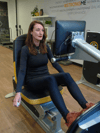
And I paid attention: to sleep, to alcohol, to all the lifestyle factors that influence bone health over time.
For more advanced cases, medication is an option. Drugs like Forteo and Tymlos are daily self-administered injections taken over 2 years; Evenity is a once-monthly injection administered at the doctor's office. All three actively build new bone rather than just slowing loss.
The takeaway is not that there’s a single solution. It’s that there are multiple entry points—if you know to look for them.
6 Questions to Ask Your Doctor Now
- Have you assessed my risk factors for osteoporosis?
- When should I have a DEXA scan?
- Am I getting enough calcium and vitamin D?
- Is hormone therapy appropriate for me?
- What kind of strength training should I be doing—and how often?
- If I’m on a GLP-1 medication, what does that mean for my bone health?
I used to think of osteoporosis as something that happened later, to someone else.
Now it’s something I think about daily: when I pick up a weight, when I think about what I’m eating, when I make decisions about my health that no one else can see.
It’s not visible.
Until it is.