Should You Try Gentle Contrast Therapy?

BLU Atelier / BLAUBLUT EDITION
Thanks to the rise of bathhouses and social wellness clubs, the daily cold plunge or sauna session has become a standard practice in the name of recovery and longevity. As a longtime wellness editor, I’ve tried contrast therapy—submerging in near-freezing water before warming back up in the sauna like a lizard in the desert sun—more times than I can count.
Lately, though, that ritual has come under scrutiny, with some doctors questioning whether these extreme temperatures are actually beneficial for women's health. As a result, many are dialing things back—or at least wondering if they should be. (Gwyneth recently shared that she now plunges sparingly, and for less time than her husband, Brad.)
So when I heard about a subtler approach called “gentle contrast therapy”—which involves less extreme temperatures and shorter sessions—I was eager to learn more and try it for myself.
How Contrast Therapy Supports Longevity
Contrast therapy—alternating between hot and cold exposure—has been a part of Scandinavian culture for over a thousand years, long before cold plunges and infrared sauna studios became a wellness trend.
Both cold and hot exposure are forms of micro-stress or “hormesis,” thought to trigger autophagy, the body’s natural process for cleaning out and repairing cells. This type of “good stress” also trains the nervous system to handle physical and psychological challenges more effectively over time. When paired, the two therapies may amplify each other’s effects, particularly for recovery. Cold exposure causes blood vessel shrinking (vasoconstriction) while heat causes vessel expansion (vasodilation), and research suggests that oscillating between the two can help improve circulation, support muscle recovery, and even minimize fatigue.
“From a longevity perspective, I think of contrast therapy as a way to build physiologic resilience,” says Robin Berzin, MD, a functional medicine expert and the CEO and founder of Parsley Health. Heat exposure, in particular, has the strongest evidence: Frequent sauna use is associated with a reduced risk of sudden cardiac death, fatal coronary heart disease, and all-cause mortality, says Berzin, and it has also been linked to a lower risk of developing Alzheimer’s. Cold exposure may support longevity indirectly through recovery, inflammation modulation, and metabolic signaling (aka supporting the body’s internal communication system)—however, Berzin notes there’s not enough research directly linking it to a longer lifespan just yet.
But it isn’t only about physical benefits. In Scandinavia, contrast bathing is often communal, reinforcing social connection—a key foundation of longevity.
Why Women May Need a Gentler Approach
The catch? Like a lot of health research, most studies on hot and cold exposure focus on men—so women are left with far less guidance on what actually works for their bodies.
What we do know is that there are sex differences with cold exposure, as research suggests women shiver at higher temperatures than men. Women also have lower sweat rates, higher body fat, and estrogen-related differences in blood vessel function, which change how we respond to thermal stress, explains Berzin. “That often makes moderate, repeatable exposure more effective than extremes,” she adds.
“While ice baths and extreme protocols have become a kind of badge of honor in wellness culture, many female bodies interpret that level of intensity as a threat, not a tool...especially in times of hormonal transition." —Jessica Sharratt, DAOM”
While more research is necessary to really understand the optimal temperatures for women, Berzin believes that a gentler approach to contrast therapy makes sense. “Women’s physiology is more sensitive to cumulative stress load. We see differences in thermoregulation, autonomic response, and hormonal fluctuations, particularly across the menstrual cycle and in perimenopause,” she says.
Translation: If you already have a baseline level of stress (and who doesn’t?), jumping into an ultra-high heat sauna or freezing cold tub of water might act as a negative stressor rather than a recovery tool. Going for a gentler approach (especially during more sensitive phases of your cycle, like luteal and menstrual) may help support your well-being without overtaxing your nervous system.
Berzin notes that this is especially important for women who are already dealing with fatigue, cortisol dysregulation, or hormonal transitions (like perimenopause). What’s more, she notes that the longevity benefits of contrast therapy are tied to frequency and consistency, not extreme temperatures.
“Women’s bodies are extraordinarily sensitive to perceived stress. While ice baths and extreme protocols have become a kind of badge of honor in wellness culture, many female bodies interpret that level of intensity as a threat, not a tool...especially in times of hormonal transition, under-fueling, or chronic overextension,” adds Jessica Sharratt, DAOM, Lac, an integrative health expert and co-founder of Heal LA, which recently started offering gentle contrast therapy in their longevity studio.
Rather than pushing the body with extreme temperatures or endurance-based protocols, “gentle contrast therapy is a more intuitive, nervous-system-led approach to hot and cold exposure,” says Sharratt.
How to Try Gentle Contrast Therapy at Home
To try it at home, simply alternate between three to five minutes of a hot shower with one minute of cold water. And, if you do have a cold plunge, set the temperature a bit higher—in the high-40s or low- to mid- 50s—or try out shorter sessions. The same goes for an at-home sauna or sauna blanket: opt for shorter, more manageable sessions at slightly lower temperatures.
And for post-workout recovery (without getting wet), Therabody's RecoveryTherm Cube offers customizable heat, cold, and contrast modes.


My Experience with Gentle Contrast Therapy
I arrived at Heal LA in Manhattan Beach, California, feeling foggy thanks to a lingering cold, and flustered after sitting in traffic. However, the moment I stepped into the multi-faceted wellness studio—which offers everything from sound healing to spiritual coaching—I immediately felt more at ease. There are multiple spaces in Heal LA, each focused on a different specialty. I checked into the “longevity studio”—equipped with an Ammortal Chamber, hyperbaric chamber, halo sauna, VEMI bed, red light, blue light, Normatec boots, and PEMF therapy.
After a tour of the facility, I was guided into a private room, where I would experience their signature gentle contrast therapy treatment. “In our Longevity Studio, this looks like pairing the multi-modality HaloSauna, which combines infrared heat, red light, color therapy, and salt, with a Cryo Dry Float, which delivers a more buffered, full-body cold exposure without the shock of traditional ice baths. Temperatures are slightly warmer, and shorter sessions are available. The goal isn’t intensity. It’s responsiveness.”
For me, the dry cold plunge was set to 55 degrees (for context, cold plunges can range from 37 to 60 degrees, and most often fall between 45 and 55 degrees). Since I was recovering from a cold, they set the sauna to green light—which is thought to be anti-infectious and calming—and recommended I do only one round of cold plunge, then a few rounds of the sauna.
In my past experiences with contrast therapy, I’ve left a session feeling invigorated but also shivering for hours post-treatment. Gentle contrast therapy felt very different—more calm, less extreme—starting with the dry plunge. I kept my clothes on and was wrapped in two silicone sleeves, like a little cocoon. Then, as I was lowered into the tub, I could feel the cold water above and below my body, as it filled the sleeves.
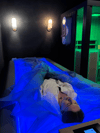
Since I wasn’t actually dipping into a tub of near-freezing water, I didn’t experience the same shock that I normally feel with a plunge—instead, it felt remarkably peaceful. After a brief cold-therapy session, I tried out the sauna, which was set to a less extreme 90 degrees, like a warm summer day. I lounged in the green light, breathing the salt-infused air (this particular sauna features medical-grade dry salt therapy, similar to sitting in a salt cave). After 10 minutes, I took a water break, then repeated it twice more. It may have been in my head—but by the end of the session, I noticed my congestion had subsided, and I could breathe a bit more easily.
As I left the studio, I felt incredibly calm, as if I’d just taken a rejuvenating nap. There was nothing extreme or intense about it—the experience was, in every sense of the word, gentle.
Is This the Future of Contrast Therapy?
For years, wellness culture has equated intensity with effectiveness, but when it comes to longevity, that may not be the case. “Some of the most profound health shifts happen when we stop trying to override physiology and instead start working with it,” says Sharratt. “That's what gentle contrast does.”
If you’re interested in trying this practice yourself, there are a number of wellness studios all over the country that offer contrast therapy—ask if they’re able to adjust settings to avoid extremes, or seek out a studio that specializes in a more gentle approach.
If you’re unsure if contrast therapy of any kind is right for your body and health goals, be sure to speak with your doctor before giving it a try. (Note: It’s not advised for people who have circulatory disorders, heart conditions, or Raynaud’s syndrome, among other underlying health conditions.)
And remember that this practice is a supportive tool, not a magic pill. “The strongest predictors of longevity are still cardiorespiratory fitness, muscle mass, metabolic health, and sleep,” says Berzin. “Contrast therapy can support those systems by improving recovery and resilience, but it works best when layered onto a strong foundation.”