
On a Saturday morning this past April, in a glass-walled studio at Equinox, my new trainer asked me to stand on one leg. I’m 54, newly postmenopausal, on HRT, and for most of my life I’ve been athletic enough that this sort of thing tends to go well.
It did. I held steady. A lunge, next—controlled, easy. Then another variation. Still fine.
It wasn’t until the sequence became more elaborate—one leg forward in a lunge, torso angled, arms reaching back behind me in a configuration that felt closer to a yoga bind than anything I’d done in a gym—that I stalled. I had to stop and watch my trainer demonstrate it again, trying to map the choreography onto my own body. When I finally attempted it, I tipped almost immediately, a small but unmistakable loss of control.
I tried again, this time moving faster, dropping into the position as if speed might compensate for instability. It didn’t. I wobbled, reset, and managed to get through it, but the movement felt rushed, slightly desperate—less strength than strategy.
It was a small moment, but a revealing one.
For the previous year, my body had become something I managed around the edges of a life that had felt, at times, overwhelming: a cross-country move to Los Angeles with my daughter, my mother’s death, my daughter’s ACL surgery, looming college admissions, and a fast-paced job in an ever-changing industry. Exercise, once a given, had begun to feel like a luxury I didn’t have time for. Standing there trying not to fall over, I had the distinct sense that something foundational—coordination, control, the efficiency of movement—had slipped in ways I hadn’t fully registered.
This was essentially why I’d signed up for EQX ARC, Equinox’s women-focused performance program. I wasn’t particularly interested in losing weight. I wanted to get stronger. I wanted better flexibility and balance. Mostly, I wanted to figure out what fitness was supposed to look like now that I was postmenopausal and my body had apparently begun making small administrative changes without consulting me.
The process began with an Equifit, Equinox’s baseline fitness assessment. Before anybody handed me a dumbbell, my main trainer, Cathy Prince, sat me down to “get to know everything there is to know about you so that your coach can program effectively.” What did I eat? How did I sleep? What kind of exercise was I doing? What were my goals? How much stress was I under? And how, exactly, did I relax? “Did I light a candle?”
I remember finding this last question oddly specific. I do own candles. Whether their presence constitutes a viable stress-management strategy was an interesting thing to ponder.
But the larger premise made sense: my body was not operating independently from my sleep, food, hormones, schedule, or stress level.
The Equifit Arc program also included an assessment of basic vitals, a functional movement screen, an Oura ring, and an InBody body-composition scan. The screen revealed that there was room to grow in “motor control.” The inline lunge was “more of a balance and coordination thing,” she said, though “overall, you’re a good mover.” I chose to hear that last part at full volume.
The scan put my body fat in a healthy range and my skeletal muscle mass at 48.3 pounds what Prince called “the biggest area of opportunity.”
At Equinox, I generally trained twice a week, Wednesdays and Saturdays, with two different female trainers. When I could, I added another strength session and some cardio or stair walking.
I had worked with a trainer before I got married, when I was around 30. My memory of that experience is essentially military-style calisthenics: strenuous, straightforward, a lot of sweating. At the time, the philosophy around fitness was not especially complicated or intentional: Work hard. Burn calories. Fit into the wedding dress, preferably with visible clavicles. Gen Z-ers think they invented looksmaxxing, but they have nothing on the Gen X women who came of age in the era of SnackWell’s and supermodels.
This training felt genuinely different.
We lifted significantly heavier weights than I had at 30, but there was also far more balance work, coordination, and core training. The heavier loads were deliberate. “It’s really important for women to lift heavy,” one of my trainers, Emiko Ono, told me. One reason, she explained, is the accelerated loss of bone density after menopause.
The exercises often required several things from my body simultaneously. A movement that ostensibly targeted my legs or glutes might also demand abdominal stability, upper-body control, and balance.
The workouts were sneaky that way.
In one exercise, I stood holding the ends of two long battle ropes and repeatedly drove my arms up and down, making waves travel the length of the ropes. It looked like something you would do to punish your shoulders. And my shoulders were, indeed, being punished. But to keep the ropes moving without allowing the rest of me to follow them around the room, I had to engage my legs, back, and especially my core.

Even the least dramatic-looking exercises had a larger purpose. In a “modified dead bug,” I lay on my back with a 10-pound round weight resting on my legs as I slowly pushed my legs out, holding the position for what seemed like an eternity. Ono explained that this targeted the deeper core muscles rather than the more visible ones associated with sit-ups. “The core muscles are the ones that really make you strong in everyday life,” Ono said. Whether I was lifting something, sitting down, standing up, twisting, or bending, she explained, that strength would help protect me from injury.
Over and over, an exercise I thought was “for” one body part turned out to require a small committee of muscles to cooperate.
That, too, was intentional. “We’re not just isolating one muscle,” Ono said. “We’re using multiple muscles, and we’re activating everything.”
That was the real shift. I wasn’t just being asked how much weight I could lift. I was being asked whether I could stabilize myself while I lifted it, coordinate movements, control my body when it was off-center, and maintain range of motion.
These were things I had never thought much about because, when I was younger, I didn’t have to.
Roughly two months into this routine, I went to get a comprehensive set of blood work done by a company Equinox partners with called Function. The test was not designed to tell me what the training had changed. The goal was to give me a more nuanced understanding of the body I was asking to get stronger.
The truth is: It had been at least five years since I had this kind of comprehensive blood work done. My focus in recent years had been on work, kids, caring for an aging parent, and managing my waning hormones, and I was frankly terrified of what the testing might uncover. They measured an absurd number of biomarkers. Getting the results felt less like opening a lab report than acquiring a terror-inducing medical dossier.
Tiffany Lester, MD, Function’s women’s health medical director, said the broad sweep was intentional. “Our approach is always more preventative,” she told me: looking for whether something is “starting to veer in a dangerous direction before you have symptoms,” or helping make sense of vague issues like fatigue or brain fog. A standard annual physical may check 19 to 26 biomarkers, she said; Function’s wider panel (100+ total) is intended to provide more context and establish a baseline for comparison over time.
The results were definitely not what I was expecting.
Biological age: 35.8.
Apparently, I was 18.4 years younger than my calendar age.
I immediately sent the screenshot to my boyfriend.
“You should frame it,” he said.
Which was obviously an appealing idea. If an app tells a 54-year-old woman with a strong penchant for buttery chardonnay that she is biologically 35, the gracious response is probably to say thank you, print it on archival paper, and stop asking questions.
Unfortunately, I am a journalist—a very skeptical one—so there was no way I was going to take this rather unbelievable report card as truth without some serious investigation.
What, precisely, was 35.8? Had Function somehow confused my vials with those of a perky millennial who did hot power vinyasa and had a standing order at Erewhon? What exactly were they measuring, and how did it make this calculation? I suspected it was some sort of soft science designed to make middle-aged people feel good and recommend the protocol to their friends.
The answer was more interesting than I expected.
Function’s explanation of biological age focuses on nine blood markers: albumin, creatinine, glucose, high-sensitivity C-reactive protein, white-blood-cell count, lymphocyte percentage, mean corpuscular volume, red-cell distribution width, and alkaline phosphatase. Collectively, they reflect things like liver and kidney function, blood sugar, inflammation, immune function, and red-blood-cell health.
Those are also the nine clinical biomarkers used—along with chronological age—in a published aging measure known as Phenotypic Age. Researchers developed the model not by asking how youthful someone appeared but by identifying the combination of ordinary blood markers that best predicted mortality risk. A lower number essentially means your clinical chemistry looks more like that of someone physiologically younger than your calendar age. It is not a declaration that every organ, cell, and joint in your body has somehow traveled backward through time.
Some of my numbers were reassuring: fasting glucose of 80, hs-CRP below 0.2, albumin of 5.0, and a white-blood-cell count of 6.0. When Lester saw the inflammation marker, she said, “Yours is great. That’s fantastic.” I had spent several days fearing the worst, so I was very relieved to get her feedback.
Other results helped identify things I wanted to address. With medical guidance from my primary doctor, I adjusted my estrogen patch to a slightly higher dose and added supplements for things I was slightly deficient in: vitamin D (shocking since I now live in California), omega-3s, zinc, and a homocysteine-factor supplement. In addition to taking vitamin D, I have also recently embraced shorts as a tactic for getting more natural sunlight exposure.
The more meaningful part of testing, Lester said, would be “the trending over time.” On a second test, “you’re really able to see very easily: It’s going up or down, or it’s about the same.” In other words, 35.8 was less a verdict than a data point.
None of this was proof of what Equinox was doing. Nor did EQX ARC prescribe those medical changes. Function was useful to me for a different reason: It helped replace the fairly useless binary of healthy/not healthy with a more important question—where could I do better?
My diet didn’t change dramatically during the program. I was already eating a lot of chicken, shrimp, eggs, leafy greens, vegetables, lentils, garbanzo beans, and edamame, while generally avoiding gluten and dairy. The significant adjustment was protein.
Lester’s food-first philosophy led to a surprisingly detailed discussion of sardines, which she crisps in an air fryer and sprinkles over salad. When I learned she meant an entire can, rather than the single sardine I had imagined, I balked. “Just try it,” she said. “Baby steps. You can do half a can.”
I stuck with my Nordic Naturals fish oil with curcumin.
Previously, breakfast was coffee, which is an excellent breakfast if one’s morning objective is productivity. Once my goal became building muscle, I started eating in the morning—usually a smoothie with two scoops of protein powder, blueberries, walnuts, spinach, and soy milk—and tried to distribute protein more deliberately throughout the day.
About three and a half months after my initial assessment, I stepped back onto the InBody machine.
My weight had changed by about a pound.
By the logic of the bathroom scale, virtually nothing had happened.
Underneath that number, however, something had.
My skeletal muscle mass had risen from 48.3 pounds to 51.1 pounds: a gain of 2.8 pounds of skeletal muscle. My body-fat percentage had fallen by 4.7 percentage points.
My trainers were thrilled.
So was I.
Not because a lower body-fat percentage is some magical achievement, or because I believe a machine can reduce health to a handful of numbers. But because the result matched the thing I had actually set out to do.
I wanted to gain muscle. I gained muscle.
I wanted to feel stronger. I did.
The numbers were satisfying. But on my final day, I got a different kind of result.
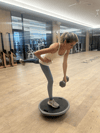
Holding a heavy weight in one hand, I stood on one leg on an unstable balance disc, hinged forward, and extended the other leg behind me while pushing my weighted arm forward. Then I returned to standing without wobbling. The move required my grip, legs, core, and balance to cooperate all at once.
A male trainer standing behind me said, “I’ve never been able to do that one.”
I doubted this was true, but I took the compliment. Apparently, this was a challenging balance act, much harder than the test I had failed at the beginning of my training.
There are obvious limits to what my experiment proves. During those months, I was strength-training consistently, paying more attention to protein, and making other health changes. I am a sample size of one; a before-and-after InBody scan cannot isolate which intervention caused which change.
But the training itself changed the way I think about what fitness is for.
At 30, I mostly wanted exercise to change how my body looked. At 54, I want it to preserve what my body can do.
The result that stayed with me wasn’t 35.8. It was what happened in training: Three and a half months after trying to use speed to disguise my instability, I could slow down, hold the position, and return to standing under control.
Today, I can also easily lift a brutally heavy carry-on into the overhead bin and a 42-pound water bottle onto a precarious pedestal—a task that had left me doused in water several months before. I have also started running long distance again and worry much less about getting injured.
That change feels more meaningful than any biological-age estimate.