I Did Panchakarma for 3 Days. Then I Checked My Oura Ring.Created with Surya

On the first morning of my three-day Ayurvedic detox at Surya Spa, I rode my bike a few blocks south from my apartment to its home in the Santa Monica Proper—which is not exactly how I imagine ancient cleansing protocols traditionally began. I had not done the four-day pre-cleanse that Surya recommends. I had not spent the previous several mornings drinking warm ghee. I had not eliminated coffee with any real conviction.
I had, however, spent much of the previous week waking up in the middle of the night, stressed and sweaty, my brain cycling through work, college admissions, and the grief I was still processing months after my mother’s death. I had shown up on time, which felt like a meaningful step in the right direction for a single working mom who relaxes by reading books with titles like I Am Not a Robot.
I should also say that I am both drawn to this kind of thing and slightly suspicious of it. I want to believe someone can read my pulse and know what is going on with me. I also want to know whether I am being hoodwinked by a sentence involving the word “toxins.”
The first thing they did at Surya was invite me into the kitchen for warm mung-bean porridge. On the table sat three large jars of churna, Ayurvedic spice blends designed to be energizing, cooling, or calming. I sprinkled the calming blend over my breakfast.
Around me were bowls of cooked vegetables, rice, spiced ghee, toasted sesame seeds, and a black lava salt that looked like something excavated from a very elegant archaeological dig. Two friends who had flown in from Florida and Texas for a girls’ weekend ate nearby, along with a couple dressed in white robes. After a few pleasantries, everyone settled into a near-meditative silence.
They seemed to understand something I was only beginning to appreciate: Surya is not simply the hotel spa at the Proper. It is its own world.
Founded by Ayurvedic healer Martha Soffer, Surya has become one of those places people discuss in the tone usually reserved for life-changing therapists, obscure facialists, and the person who finally fixed their gut. I was there for three days of Panchakarma, an intensive Ayurvedic cleansing and restoration protocol. The Sanskrit name means “five actions” or “five therapies” which refers to the five historical methods used to eliminate what Ayurvedic practitioners consider accumulated waste or imbalance in the body.
Before anyone poured oil on me, Soffer led me into her office, where an entire wall was lined with massive jars of Indian herbs she uses to make her treatment oils. A small sculpture of Ganesha, the elephant-headed Hindu god associated with wisdom and the removal of obstacles, sat among the crystals and incense.
Soffer took my pulse, looked at my tongue, and began asking questions. How was my sleep? My digestion? My hormones? My joints? Had I had recent blood work? What were my bowel movements like?
Standing there with an Oura ring on my finger, I suddenly felt very attached to the wrong kind of data.
With a slightly embarrassed gulp, I told her everything.
I had come in thinking I was getting a glorified massage. This felt more like an intake appointment. Soffer studied the grooves in my tongue the way another person might study a map.
She identified me as Pitta-Vata, a dual dosha that, in Ayurvedic terms, meant my treatment would focus largely on cooling, calming, and grounding me. Given the week I had been having, I was willing to concede that this did not sound entirely off base.

The diagnosis also informed the oils she would use. Soffer does not pull a bottle from a shelf and use the same thing on everyone. The herbs in the room were there for a reason.
“It will be your jar with your name and your herbs,” she told me. Sometimes, she said, the oils cook overnight; sometimes for three or four days. If something changes, she may add another herb and cook the oil again.
Soffer talks comfortably about toxins, tissue layers, channels, elimination, and rejuvenation. I remain skeptical of sweeping wellness claims. But I am comfortable saying this: Soffer and the practitioners who worked with her paid attention in a way that is increasingly rare.
The next morning, after another light vegetarian meal, I was led into a low-lit treatment room. I lay facedown on the table, my head in the cradle, and Soffer asked me to breathe deeply through my nose. As I took in the intense herbal scent, my shoulders dropped.
It normally takes me a while during a massage to fully relax and stop thinking about what I’m going to buy for dinner at Trader Joe’s. But something about this particular blend seemed to calm my nervous system almost immediately.
Then the four-hand abhyanga massage began.
Soffer and another therapist worked in synchrony, moving warm, herbalized oil over my back, legs, arms, scalp, face, hands, and feet in long, rhythmic strokes. It is difficult to describe the sensation of having warm oil poured into the small of your back while four hands massage you from head to toe without making it sound ridiculous, or like something a very rich Roman emperor might have ordered before lunch.
There were too many hands for my brain to track. Eventually, I gave up trying and floated around in a sort of cosmic mental cloud for the next hour and a half without once thinking about the cost of SAT tutors.
This, I realized, was unusual for me. I make lists. I check my phone. I anticipate what might go wrong. Even when I am technically relaxing, some part of my brain is usually standing guard. For once, it had apparently checked out.
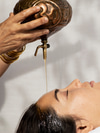
Afterward came shirodhara, in which warm oil is poured in a continuous stream across the forehead. In Ayurveda, the treatment is intended to calm the mind and is often associated with the “third eye.” I cannot speak to my third eye, which has always seemed like it might prefer to remain closed, but I can say that the sensation was deeply sedating.
Next came swedana, an herbal steam treatment. My body was enclosed beneath a tent while my head remained outside, with a cool towel placed at the base of my neck. Under normal circumstances, I have a hard time sitting still and doing nothing for 20 minutes in a sauna. Here, while I sweated, the practitioners massaged my hands and arms.
This turns out to be an extremely effective way to keep an impatient Pitta-Vata from trying to leave early.
According to Soffer, the combination of oil, massage, and herbal steam is intended to support the elimination process central to Panchakarma. I cannot tell you what was happening inside seven layers of tissue, but some of the effects were less mysterious. My body did, in fact, become extremely interested in using the bathroom, and after hours of massage, steam, and lymphatic work, I looked noticeably less puffy when I got home.
Over three days, my protocol included more abhyanga massage, swedana, shirodhara, nasya, yoni steaming, and ear candling. At Surya, the nasya treatment involved bodywork across my chest, back, neck, head, and face, followed by drops of Brahmi oil in my nose. According to Soffer, the treatment is designed to clear the sinuses and “improve the breath.”
A strangely satisfying highlight came on day three, when a practitioner placed a hollow candle at the opening of each ear and lit the far end. Afterward, I watched her remove what looked like a baby-caterpillar-sized amount of wax from each ear. Later that day, when I got home, I swear I could hear a little better.
That night, I checked my Oura ring.
This is not something Martha Soffer would do.
When I interviewed her separately about her morning routine, I asked whether she used a sleep tracker. “I don’t like to be connected to anything,” she said. She wakes before 6, meditates, moves her body, and gives herself a traditional oil massage.
I wake up and ask a piece of Finnish hardware to tell me how I felt. Unlike Soffer, I could not wait to see what my device had to say.
The week before my treatment, my daytime stress graph had been crowded with pink spikes. During my three days at Surya, those spikes largely disappeared, replaced by long stretches of blue. One day, the app informed me, with the enthusiasm of a kindergarten teacher handing out a gold star, that I had experienced more restorative time than usual.

That was something of an understatement.
The Oura ring was not proving that Ayurveda had cleared toxins from seven layers of tissue or opened my third eye. It was showing me something narrower and, in its way, more interesting: While I was at Surya, my body was registering a dramatic shift from stress to recovery.
Was it the custom oil? The four hands? The steam? The attention? Or simply the fact that, for roughly four and a half hours a day, three days in a row, someone made me stop talking, working, scrolling, planning, and solving problems?
I don’t know. And that uncertainty bothers me less than I thought it would.
I arrived by bike, underprepared and mildly anxious, and left feeling as if my body had been persuaded—not forced, not hacked, not optimized—into a quieter state. And for that, I was grateful.
How to Properly Prep for Panchakarma
I did not do the full pre-cleanse, but for people who want to do Panchakarma properly, Surya recommends several days of preparation at home before treatment.
That includes following a diet centered on warm, cooked, vegetarian foods that are easy to digest: mung beans, basmati rice, dal, kitchari, soups, cooked vegetables, and herbal teas, while avoiding things like alcohol, caffeine, dairy, meat, raw foods, and heavily processed foods.
The more traditional prep can also include snehana, or taking warm ghee on an empty stomach, followed by an elimination step. This is not something to improvise casually; the exact protocol should be determined with Surya or another qualified practitioner, particularly for anyone who is pregnant, taking medication, or managing a health condition.
After Panchakarma, Surya recommends easing gradually back into regular eating rather than going directly from kitchari to martinis and steak frites.
Which is rude but probably a good idea.