
My mother has been smiling in her sleep for three days now. It’s a soft, amused smile—like she’s watching Tom Selleck in a dream. Occasionally she opens her eyes, sees me, and lights up like a five-year-old spotting her birthday cake for the first time. “Who is that lovely lady? Is that my Amy?” she asks, delighted. “Yes, mommy, it’s me,” I say gently, covering her face with soft kisses and running my fingers through her silky gray hair. She purrs like a kitten.
I’ve been sitting in a wheelchair beside her bed since Monday. Around 6 a.m. that day, I had gotten a call from Jared, her hospice case worker. I knew before I even picked up the phone that it was the news I’d been dreading for months. “It’s time,” he said. I felt the floor drop in my stomach. I don’t remember anything else he said.
The next few hours were a blur: I booked a ludicrously expensive one-way flight to Naples and tossed a few of my mom’s favorite Amy-in-Florida outfits into a tiny Tumi bag, tears streaming down my face. At some point, through a watery veil, I explained to my 17-year-old daughter what was happening. “Oh mamma, I’m sorry,” she said, hugging me. I think the only time she’d ever seen me this unglued was when we put our dog Lucy down the year before. At the time, she had helped carry the body bag out of our NYC apartment because I was shaking too hard to function. But this—this was infinitely worse. My mother was my North Star, the root of every loving impulse I possessed. Even as her cognitive health declined over the past few years, our bond remained grounding, alive.
I thought I was prepared. I wasn’t.
On the flight from LAX to Fort Myers, I tried to work but couldn’t focus. So, I surrendered to the sadness and listened to a playlist I hastily titled "Mom’s Songs." There was Peter, Paul and Mary. Joni Mitchell. Gordon Lightfoot. I must have listened to "If You Could Read My Mind" 20 times as tears streamed down my face. I stared out the window, ruminating on what it meant to officially become an orphan. When the pilot announced, “We’re flying over the Gulf of America,” I snorted—half-hysterical. The couple next to me handed me a tissue with a sympathetic smile.
I arrived in Naples just after sunset—one of those lavender-orange horizons I’d tried to photograph countless times during my visits over the years. As I stepped out of the Uber, I realized this would probably be the last Naples sunset I’d ever see.

When I entered her room in the memory care center, I opened the door slowly. She lay quietly in bed, hands folded, a serene smile on her face. She looked shockingly thin—at least 10 pounds lighter than when I’d last visited. As I approached, she opened her eyes and smiled politely. “Oh hello,” she said, as though I were a kindly caregiver there to adjust her pillows. But then something clicked. Her eyes widened. “It’s you! You’re here. I’ve been waiting for you.”
“Do you know who I am?” I asked.
“Yes, you are my best friend.”
“That’s right, Mom. I’m your best friend—and your baby.”
“Yes,” she whispered, closing her eyes. “My beautiful, beautiful baby. And I am so, so lucky.”
She slept a lot those first couple days. I tried to work but worried she might slip away while I was in another room. Eventually, I stopped trying. I allowed myself to be fully present. And in that stillness, something profound happened.
I was baptized Episcopalian but raised agnostic. My mother lost her mother as a baby and wrote her college thesis on the “non-existence of God.” My father, a lapsed Catholic, liked to quote Marx: "Religion is the opiate of the masses." I cobbled together my own moral philosophy over the years, but one persistent, gnawing question lingered: What do I do about death?
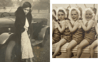
Left: My grandmother, Pauline Stillwell, was a gifted artist who died when my mom was a baby. Right: My mom, center, spent her early years being cared for by nurses at the Royal Victoria Hospital in Montreal, where my grandfather worked as a surgeon.
For decades, I avoided the thought. Shakespeare's line haunted me: life as a “walking shadow,” a tale told by idiots, signifying nothing. But here, in Naples, beside my mother, something shifted. She was not afraid. She was radiant, peaceful. Her happiness was uncomplicated and complete. Being surrounded by love was all she needed. And in that, I witnessed something like transcendence—as if her body was dissolving and what remained was spirit, connected to something vast and deeply loving.
The days slowed. Time warped into a rhythm of small rituals: a bite of cookie, a sip of cold Sprite, a facial massage with a dewy herbal serum. I applied Chanel lip gloss to her dry lips and told her she looked like a “ripe peach.”
“Oh no,” she said, suddenly an uncanny echo of her former self. “I’m an old, old onion.”
These moments of clarity were punctuated by hallucinations so vivid I began recording them. There was a machine, she told me. Complex, with many parts. It needed someone to watch over it—me. “You only see parts of it at a time,” she explained. “But you’re doing a very good job.”
I asked the hospice nurse if it could be the morphine. She shook her head. "More likely it's something we call Terminal Agitation," she said. "It's a restlessness that can occur as the organs are shutting down and a person is in the final hours or days of death." I couldn't shake the suspicion that the pain medication had given psychedelic wings to the restlessness, but I didn't want my mom to be in any pain so I put total faith in the string of hospice nurses who accompanied me in those final days.
Whatever the cause, it was hard not to see symbolism in these hallucinations: The machine mattered, and I was keeping it going. Every time the nurse would administer morphine, my mom would smile and say, “My head thanks you.” Then she’d thank me again for working the machine. And then, as if nothing had just passed, she’d begin talking about toes.
As the days passed, her visions grew more focused. She spoke of a woman near the ceiling, working. She described places we were moving to—methodically, deliberately.
“Where are we moving, Mom? Is it nice?” I asked.
“It’s a little hard to decipher,” she said, eyes closed.
And then she repeated what she had been saying since I arrived:
“We are very lucky. So lucky to be so happy.”
Every time, I agreed.