A Puglian Getaway, 3 Ways
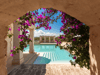
Photo courtesy of Borgo Egnazia
For our first child-free vacation together in seven years, my husband and I headed to Puglia, the heel of Italy’s boot, in search of dolce far niente: the sweetness of doing nothing. When you have small children, and you suddenly find yourselves without them, doing nothing is about as luxurious as it gets. And because we didn’t have little legs in tow, we decided to divide our trip into three very different styles of vacationing, packing up and relocating every few nights, tasting life at a classic masseria, a converted monastery, and a full-service luxury resort.
The Masseria
Our first stop: Masseria Trapana. Masserias—traditional Italian farmhouses designed as miniature fortresses enclosing courtyards and gardens—are one of the signature styles of life in Puglia, and many have now been converted into boutique hotels, as well as working farms and restaurants.
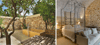
Hidden beyond a long dirt road, Masseria Trapana is the kind of place that encourages you to slow down. Lemon and fig trees shade the gardens, cicadas sing from sunrise to sunset, and a soundtrack of 50’s hits and mellow contemporary music drifts quietly across the property. The intimate, nine-room masseria includes an infinity pool, a subterranean hydrotherapy pool housed in a former olive oil mill, a restaurant, a fire pit, and a 16th-century chapel, all painstakingly restored by Australian owner and former marketing executive Rob Potter-Sanders before its 2015 opening.
Photos courtesy of Masseria Trapana
Our suite—a stunning bedroom and living room with 18-foot ceilings—was attended to like clockwork: fresh laundry appeared in the closets after breakfast, and homemade cookies on our pillows at turndown service. And yet we never saw a soul.
“The best masserias are the ones where the owners are present,” one of our fellow guests, a Puglia travel expert, told us over rosé by the pool. Potter-Sanders, who designed the hotel himself, divides his time between the masseria and his native Sydney, and has imparted the space with his own Australian sensibilities: there’s a burger with pineapple on the lunch menu, vegemite at the breakfast buffet, and Aesop bath products in every washroom.
Food at Trapana was simple and fresh and served on a beautiful terrace, though the warm waitstaff were more memorable than the dishes themselves. “Can we have our gelato inside so we can FaceTime our son?” we asked during our only dinner on the property. “Of course,” our server said. “This is your house.”
Photos courtesy of the author
In addition to ample time by the pool, we spent an afternoon wandering Lecce, the “Florence of the South,” fueled by caffè leccese—espresso poured over ice and sweetened with almond syrup—and a memorable lunch of burrata, crispy artichokes, and honey at Doppio Zero. We capped it off with a scoop of Agricola's signature goat's milk gelato. With bougainvillea spilling over balconies and jasmine climbing limestone walls, Lecce feels less like a tourist destination than a city going about its daily life. Just don't expect to shop between 1 and 4 p.m. when everything shuts down for the daily riposo.
The Converted Monastery
From Masseria Trapana, we drove 45 minutes south to Il Convento di Santa Maria di Costantinopoli, in Marittima. Upon arrival, we were greeted by Athena McAlpine—an Irish-born, London-raised Greek and the owner and designer of the Convento—and her giant White Swiss Shepherd, Leo.
McAlpine toured us through the courtyard (replete with folk art and African sculptures), through the long hallways with custom cabinetry, tables, stools, and chairs holding hundreds, no thousands, of books, on to the pool and gardens, the communal kitchen (“help yourself”) and tantalizing sitting areas, both indoor and out. Notably, our “private bathroom” was across the hall from our room—“streaking distance!” our hostess told us with a mischievous smile. “Ok,” Athena said at the end of the tour. “You’ve got the keys, you saw the pool, here’s the bottle opener. That’s pretty much it.”

Photos courtesy of Il Convento di Santa Maria di Constantinopoli
The design is maximalist, to be sure, but there is a careful resting place for every book, tapestry, and sculpture. Athena, who restored the monastery with her late husband, Alistair McAlpine—the former editor-in-chief of The World of Interiors—described their partnership simply: he was "the builder, the collector, the Renaissance man." She was the "editor, straightener, organizer."
We settled into life at the Convento with ease. Mornings at the communal breakfast table were a feast of fresh focaccia, pastries, homemade granola, fruit, and pressed juices, from 8:30 a.m. to 1 p.m. Just like at home, where everyone inevitably gathers in the kitchen, we found ourselves lingering by the refrigerator—after pouring a caffè leccese from a pre-batched bottle—chatting with our fellow guests, all artists and creative types, and with Athena.
If you wish to partake, lunch is served at 2 p.m., dinner at 9 p.m. There is no menu; this is not a restaurant. Pierluigi, the cook, is more like your uncle who is whipping something up for dinner, and it’s going to be very good. We greedily ate every delicious plate put in front of us.

Photos courtesy of Il Convento di Santa Maria di Constantinopoli
The Convento, with just eight bedrooms, is not your typical luxury hotel. “Someone once said we’re like Vegemite,” Athena told me. “You either love it or you hate it.” The staff feels more like family members, happy to help, but they’re busy, too, and fending for oneself is encouraged. Your bed will be made, your bathroom tidied, but you will be tending to your own luggage here. And, perhaps most notable for some: there is no air conditioning.
A hand-drawn map, tacked onto the fridge with magnets, depicted our seaside itinerary: boating at Castro Marina, a dip at Acquaviva, another swim at Tricase Porto followed by aperitivo at Tricase Bar Balboa, a bed and brolly at Athena’s preferred lido, Elite.
The sea was clean, cool, and full of caves to explore. In the south of Puglia, it’s all about the clear blue water, the rocky beaches, and umbrella-lined lidos, a Slim Aarons photo come to life. We washed each day down with more Campari spritzes than I could count.
I guess I love Vegemite because I could spend a month—or six—at the Convento. I want to sit in every tiny chair, to view the courtyard, the pool, the gardens, from all angles, behind every prickly cactus. I want to slowly thumb through the books that Athena pulled out for me, like Writer’s Houses by Francesca Premoli-Droulers. “Collecting is a form of addiction,” she admitted. “My extravagance could know no bounds.” I’d need a year, a lifetime maybe, to satisfy my itch to explore this rich world, this dream state of a property that Athena has created.
The Luxury Resort
It was a bit of a culture shock to go from the quiet, charming convento — easily among the most unique properties I’ve ever visited—to a 45-acre luxury resort like Borgo Egnazia, a nearly two-hour drive back north. Built from the ground up and opened in 2010 by the Melpignano family, Borgo Egnazia is designed to look and feel like an idealized Puglian village, with winding streets, courtyards, piazzas, and multiple neighborhoods, all constructed from local limestone and featuring artisanal craftsmanship. The amenities are endless: three pools, multiple restaurants, a world-class spa, a beach club, a wellness program, tennis courts, golf, kids’ clubs and more.
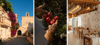
It’s yesteryear for the staff, too, who wear traditional linen dresses, belted at the waist for a look that is less uniform than costume. As we strolled through the “town square” —giant, prop-like baskets filled with almonds, lemons, and decorative water bottles in every corner—I couldn’t help but feel like I was walking through a film set. Nights are more theatrical and, arguably, more beautiful, as the entire village is lit with thousands of candles.
Photos courtesy of Borgo Egnazia
The ambiance may be divisive, but there is no argument that the food at Borgo Egnazio is excellent. Dinner at Cala Masciola, the seaside restaurant, included a fresh sea bass—hand-selected from the day’s catch—grilled, with a classic Mediterranean sauce of olives, tomatoes, olive oil, and capers. Also notable was the breakfast buffet, which had enough food for an army of gourmands, including a large gluten-free table with homemade breads, pastries, and packaged snacks.
One could easily spend a week at Borgo with a different daily itinerary. I would happily make my way through every treatment on offer at the stunning Vair Spa. But my husband can’t be confined anywhere for long (even a 45-acre hotel village), so we rented a 1974 Alfa Romeo Spider from Puglia Auto Classica and took it for a spin to nearby Alberobello. A charming little town, Alberobello is famous for its trulli—whitewashed limestone houses topped with conical stone roofs. It was nearly 90 degrees and the historic center was jam-packed with tourists—but the storybook rooftops are worth seeing. Even if you do little more than wander the winding streets with gelato, it's the kind of place you'll want to photograph from multiple angles.
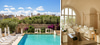
Photos courtesy of Borgo Egnazia
The drive back—with the top down, ancient olive groves blurring past, and quiet country roads stretching ahead—was one of my favorite memories of the entire trip. Each of our three stays had offered its own fantasy—from a whitewashed masseria to a time-traveling borgo to a glamorous seaside escape—and the vintage Alfa felt like the perfect final act, like something straight out of a Bond movie. The kids were at home, but I guess we all like playing pretend sometimes.