What Island Hopping in the Aegean Taught Me About Slowing Down

Photo courtesy of Empiria Group
On our first night at Phāea Blue, on Crete, my friend and I sat down to dinner outside, beneath the olive trees in the hotel’s organic garden. The hotel calls it the Phāea Farmers Feast: a communal dinner built around ingredients grown on the property, with the chef walking us through what we were eating and where it had come from.
At one point, he reached up, plucked a long brown pod from a carob tree, and placed it in my hand.
“The seeds are very, very hard,” he warned.
The shell cracked between my fingers, exposing a dense, chewy interior that tasted somewhere between dates and caramel. I knew carob mostly as a vaguely virtuous substitute for chocolate, the sort of ingredient sold in beige packaging at Whole Foods. I had never stopped to consider what it looked like before someone ground it into powder, much less that the carob turning up in dessert might have been growing a few feet from the table.
Herbs grew all over the property too, and you would encounter them again in the food. That became one of the pleasures of being in Crete: ingredients seemed to have traveled an unusually short distance before reaching your plate. Mint sharpened the tzatziki. Olive oil came from trees whose trunks looked old enough to remember several civilizations.
Earlier that day, a closure on the main road sent our driver, Adonis, onto a series of switchbacks through the mountains. We passed villages where tiny stone houses appeared to have grown directly from the earth. At one bend, a gray chapel with a red-tile roof sat pressed against a rust-colored rock face, its white cross almost disappearing into the mountain. Olive trees crowded the road, their trunks thick and contorted.
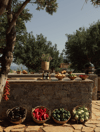
“The fatter the tree, the richer the oil,” Adonis said, pointing through the windshield. “You don’t want a tall olive tree. You want a fat one.”
By the end of the trip, I would have had two drivers named Adonis. Both had lived on their islands all their lives, as had generations of their families; both treated a car ride as an unofficial tour, giving a running account of whatever happened to be outside the window. With Adonis, a detour was not lost time. It was part of the trip.
Phāea Blue sits above Elounda Bay, and when I first arrived, I wasn’t particularly interested in leaving my villa. We had a pool overlooking the mountains and water so intensely blue it almost looked artificial. That first day I read by the pool until I lost track of time.
Eventually, I wandered downhill.
The paths pass stone walls, bougainvillea, jasmine, and olive trees, and on warm days you can actually smell the jasmine before you see it. At the bottom is the hotel’s white-pebble beach, dotted with straw-topped umbrellas, looking out over the water toward Spinalonga. It felt wilder down there than it did from the pool—less manicured, more like the landscape had been left mostly alone.

At Blue Door Taverna, a former fisherman’s house at the water’s edge, I ate plump shrimp folded into kritharoto, the rice-shaped orzo coated with their juices, followed by the most delicious fava and tzatziki I had ever eaten.
I also had an excellent massage at the hotel’s spa, which after several days of ferries, cars, and carrying too many ceramics felt less optional than it sounds.
The ceramics became something of a theme.
One afternoon, our driver took us to Old Hersonissos. There are tons of cute, local, non-touristy shops here. My favorite was Maria Sanoudaki Ceramic Art Studio, where I bought hand-painted coffee mugs and, as I do everywhere I travel, a Christmas ornament.
In Plaka, I made my way into another shop brimming with work by the Cretan artist Dimitris Limberidis. Plates and olive-oil bottles were hand-painted with blue and pink octopuses, fish, and olives, along with adorable little ceramic sardine cans that looked like tiny sculptures. I nearly bought one despite not liking sardines, but settled on a small, hand-painted green flower dish for my daughter to keep her jewelry in. For myself, I chose a corked olive-oil dispenser with pink tentacles winding around its belly.

Crete was also where we found Noema Wine Bar, entered through one of the blue doors that appear everywhere on the island. Inside, the space felt cave-like—a great place to try local wine and sit for a while without feeling like you were supposed to be doing anything else.

The next day, we left from the hotel on a traditional wooden caique, one of those old Greek boats that looks infinitely more appealing to me than anything sleek enough to require removing your shoes before boarding.
From the water, Crete became mountains, coves, and little beaches. We passed Spinalonga, the small island just offshore with the remains of its Venetian fortifications rising above the sea, while the crew put out Cretan cheeses and lunch.
We debated jumping overboard, then stayed exactly where we were and watched the water instead.
We left for Santorini the next morning on an early ferry.
Disembarking was mayhem. The ferry is insanely crowded, and they herd you out like cattle. Another passenger began wheeling away my black suitcase—with the pink octopus, several other ceramics, and a box of baklava inside—before I caught him.
A note to future ferry riders: Tie something weird to your bag. There is no better place than a crowded ferry ramp to discover that half the world owns the same black roller.
At Istoria Beach, in Perivolos, the black volcanic sand nearly scorched the bottoms of my feet. The hotel has enormous urns, arched openings, and rounded architectural details, rather than the more predictable blue-and-white version of Greece. The building was once a private home with stables, and references to that history appear throughout, including old bridles and other equestrian details worked into the design without making the place feel themed.
Relief from the sand came beneath an umbrella, where a friendly server delivered fried calamari, Santorini fava with roasted cherry tomatoes, and a cold glass of Assyrtiko from Mr. E, the hotel’s local restaurant.
The wine was one of the things I became slightly obsessed with on Santorini.
Driving around the island, you see grapevines unlike the orderly rows you might find in Napa or Bordeaux. They grow close to the earth, trained into low, basket-like coils to protect the grapes from Santorini’s unrelenting winds. The volcanic soil and dry climate are part of what makes the island’s Assyrtiko so distinctive: bright, highly acidic, often saline and mineral-tasting, and especially good when it is very cold, and you have just nearly burned your feet on black sand.
Later, we moved to Istoria Cliff in Firostefani. Here, the vibe was completely different, with iconic whitewashed exteriors, cave-like rooms, and the full caldera fantasy.
Our suite was carved into the cliff, with a small plunge pool seemingly suspended above a blue horizon so expansive it felt like a portal into an oceanic metaverse. This was the Santorini I had seen in photographs, only more beautiful and somewhat surreal in person.

The next morning, breakfast arrived at our suite: soft, almost custardy scrambled eggs with feta and some of the sweetest tomatoes I could remember tasting, scattered with scallion, dill, and parsley. I ate every bite while looking toward the caldera.
We headed to the Tomato Industrial Museum, a sleeper hit I would definitely recommend adding to any trip here.
Housed in the old D. Nomikos tomato factory, it tells the story of a Santorini that existed long before infinity pools became an industry. Tomatoes were canned here; volcanic earth was mined; people made wine, boats, and, apparently, socks.
“They used to make socks,” curator Lefteris Zorzos told me.
“No more socks?”
“No more socks.”
When the factory was operating, they wasted virtually nothing. Seeds went back to farmers to plant or feed to animals, and rainwater collected in underground cisterns became steam for the machinery.
The factory closed in 1981, but its old carts, gears, cans, and machinery are still there—a reminder that Santorini had been producing things long before it began selling views.
After the tour, we stopped by the gift shop, where we got vintage tomato cans and a can of tomato paste still made under the old label. From there, we moved outside to a small café that felt like a love letter to the Santorini tomato.
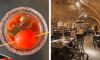
A bowl of intensely fresh tomato paste arrived with crackers for dipping, followed by what may have been the best Bloody Mary I’ve ever had. It came garnished with a juicy tomato skewered across the top, along with grape leaves and fresh capers—the same capers we could see growing beside us.
The whole thing reminded me of visiting a winery, only instead of moving through a flight of Chardonnays or Assyrtikos, we had essentially done a tomato tasting. After spending the morning looking at old squeezing machines and canning equipment, we got to taste why any of it existed in the first place.
Later that evening we ate dinner at Alati, a 400-year-old wine cave in Vedema. We pulled leaves from a whole roasted artichoke brightened with lime, then shared grilled lobster with bisque and pasta and yet another bowl of fava. By then, I had eaten more fava in five days than in my entire lifetime. As we left, I noticed a tiny kitten crouching near the entrance, eating from a small bowl someone had set out for it.
I had seen cats everywhere in Greece: creeping beneath café chairs, sleeping on sun-warmed walls, eating from bowls tucked discreetly beside hotels and restaurants. I thought of Zoey, my friend’s outdoor cat in Hollywood, whose excursions generate nearly daily calls from neighbors convinced she has been lost or abandoned.
In Los Angeles, an unattended cat will trigger an immediate rescue operation. Here, nobody appeared remotely concerned. Someone had put out food. Someone else would probably put out water. The kitten was being looked after without anyone feeling the need to bring it inside, attach a GPS tracker to its collar, or establish exactly who was responsible for it.
It lifted its head for a moment, looked at us, then went back to dinner.
I had gone to Greece expecting it to be beautiful. And it was—far more than I could have ever imagined.
But what I remember now are the smaller things: carob cracked open under an olive tree; the smell of jasmine on the way to the beach; the unbelievable blue of the water off Crete; grapevines curled against the wind; tomatoes that tasted so sweet you were reminded they are a fruit; a wooden boat passing Spinalonga; and a kitten outside a wine cave, fed by someone and fussed over by no one.
The pleasure was in having enough time to notice all of it.