Decoding the Enduring Appeal of Carolyn Bessette-Kennedy’s Style
We cover things we're into and think you might be, too. If you purchase through an external link here, goop may earn a commission.

Recently, Ryan Murphy’s hit show Love Story has reawakened an interest Carolyn Bessette-Kennedy—and reignited a mania for her style. But the truth is that Carolyn never really left the fashion conversation. Since she first rose to public consciousness as John F. Kennedy Jr.’s girlfriend, her image has been pored over endlessly—in tabloids, on moodboards, and, in recent years, all over social media. For three decades, designers, stylists, and shoppers have studied her wardrobe, hoping to understand its perennial hold.
Bessette-Kennedy’s style, however, is difficult to replicate. Mainly because it had more to do with her, as a person, than with the clothes that she wore. Carolyn had the ineffable qualities of an It girl. Her sharp mind and advanced understanding of fashion were vital. But her fashion choices—and the way she wore her clothes—were always deeply, and authentically, individual. And yet, there are lessons to be taken from the elements that defined her style.
’90s Minimalism
Describing Carolyn’s style as minimalist is an oversimplification, but minimalism is inseparable from the time in which she lived. In the ’90s, Carolyn worked as a publicist for the house that defined the aesthetic, Calvin Klein. And working at Calvin came with rules, especially for Carolyn, who was not just an employee but a muse. Staffers were expected not just to wear the line themselves but also to adhere to the brand’s pared-back ethos: no nail polish, no flashy color, little makeup.
As Sunita Kumar Nair, author of the style tome CBK, explains, the aesthetic shift happening in fashion mirrored a broader cultural moment: “When we talk about minimalism, it was happening in art with people like Donald Judd and John Pawson.” And in photography, where the work of Mark Borthwick, Mario Sorrenti, and Steven Meisel “was a stripping away of this overglamorized, oversexualized woman that was a part of the ’80s,” Nair says.
Fit, Shape, and the Illusion of Ease
Carolyn’s style is often cited as a beacon of effortlessness, and it’s true that she favored simple pieces like jeans, shirts, slip dresses, and tailored coats. But simplicity doesn’t always equal ease—in fact, it often requires the opposite. Without print or embellishment to distract the eye, attention to fit, silhouette, and quality are essential.
“There has to be some kind of curation element when you are choosing to dress the way that she did,” says Nair. “It’s like simple maths: The perfect jean plus the perfect shirt...but everything has to fit exactly right.”
Carolyn was known to invest in quality materials and often recruited designer friends to help with tailoring and fit. Her intense dedication complemented her innate eye. She only made it look easy.
An Absence of Color
Carolyn’s wardrobe existed largely within what Nair describes as an “absence of color”—a concept first coined by Coco Chanel. Her closet was mostly black, white, beige, and brown, with the occasional navy or grey. Color appeared rarely, and only with careful restraint. Carolyn herself has been quoted saying that if she wanted to add interest to an outfit, she would do it with texture rather than shade.
The Power of Mystery
A less-tangible key to Carolyn’s allure was mystery. In an age before personal branding and self-documentation, Carolyn actively avoided cultivating a public persona. Friends said she deliberately dressed down in order to downplay her natural beauty, avoiding clothing that felt too attention-seeking.
The Shirt

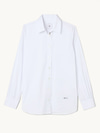
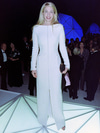
Few pieces are more associated with Carolyn than the classic button-up. She wore (mostly black or white) shirting both on- and off-duty, and, unexpectedly, for formal events. One of her most referenced looks is a white crossover shirt by Yohji Yamamoto that she wore to a black-tie Whitney Museum dinner in 1999 (pictured above).
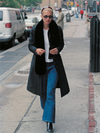
On more casual days she was photographed walking through Tribeca in similar styles paired with jeans and flip-flops—a look that inspires the uniform of many downtown New Yorkers today. Carolyn was known to find some of her favorites in the menswear section, a habit that lent her style a casual ease.
A New Yorker in Motion
Another reason Carolyn’s style continues to resonate is its practicality. She dressed like someone with places to be (because, of course, she was). Even after becoming one of the most photographed women in America, she was often spotted out and about—on the subway, running errands, meeting friends. Her wardrobe reflected this.
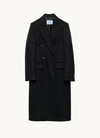
Carolyn relied on coats, many from Prada, as a sort of armor. This was where she had a bit of fun, too, indulging in prints or astrakhan. Her accessories were practical: loafers, low heels, even sneakers; labelless designer bags (she preferred to carry in hand, rather than slung over the shoulder); and—a constant—oval-framed sunglasses from Selima Optique.
The Logic of Her Formalwear
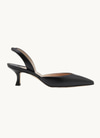
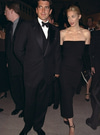
Carolyn’s eveningwear followed the same logic as her day looks. She often wore black or nude dresses (many by Calvin Klein) paired with classic Manolo Blahnik heels. She rarely wore jewelry, not wanting to interrupt the line of her look, but occasionally accessorized with a glove or a red lip.
A Thinking Woman’s Wardrobe
Perhaps the most important element of Carolyn’s style was her fashion know-how. She gravitated toward designers like Prada, Yohji Yamamoto, Ann Demeulemeester, and Calvin Klein, whose work was provocative and expressive.
“She just understood clothes,” Nair says. “When you understand clothes, you understand and respect the designer—and then the clothing suits you.” Nair describes Carolyn’s wardrobe as “a thinking woman’s closet,” one built on intellect and intention.
The CBK Edit