The Rise of the Starter Facelift

Photo courtesy of Richard Vergez
For Lisa Alvarez, a 45-year-old nurse practitioner and partner in a San Diego cardiology practice, it began, like many things in one’s perimenopausal years, with a hard look in the bathroom mirror.
Her upper lids were beginning to droop, obscuring her blue eyes. A pouch had developed under one eye. Her neck was a little loose. In the morning, she says, she’d wake up and stare at that under-eye bag, trying to will it away. It wouldn’t budge, she recalls, no matter how many creams, serums, eye masks, and gadgets she applied. “I was getting those eyelids that my grandma and mother had.”
Over the years, Alvarez had not exactly been neglecting herself. Starting in her late twenties, she had committed to a battery of non-invasive tweaks: Botox, lasers, ultrasound, and microneedling. The regimen worked for a long time. Until one day, it didn’t.
“Social media is everywhere, and whenever I saw myself on camera looking tired, I didn’t like it,” she admits. “I started to nitpick, and everything was beginning to look pulled down and droopy. But I don’t feel droopy. I exercise five or six days a week, and I have a lot of energy. My face was not correlating with the way I feel.”
In the end, the moment that pushed her from dissatisfaction to action was not her own reflection. It was a colleague. One day last spring, Alvarez arrived at the cardiology practice at which she is a partner and saw a 55-year-old male doctor she works with looking startlingly refreshed. “We work hard, and he always looked rugged and dragged out,” she says. “But when I saw him that day, his eyes were more open and sparkly, and his skin was brighter.”
When she pressed him, he told her he had gone to Babak Azizzadeh, MD, a Los Angeles facial plastic surgeon known for his mastery of facial nerves and natural-looking facelifts.
Though Alvarez was nearly 10 years younger than her colleague, she made an appointment with the same doctor. After reviewing before-and-afters that seemed almost too good to be true, she signed up for the works: a facelift, neck contouring, endoscopic brow lift, blepharoplasty, laser resurfacing, fat grafting from her knee and inner thigh, a subtle rhinoplasty, and CO2 laser. The cost was roughly $170,000.
The Rise of the Starter Facelift
Just a few years ago, facelifts were still largely seen as something women did in their fifties or sixties, ideally without anyone noticing. But Alvarez is part of a younger cohort that has come to see surgery less as a dramatic last resort and more as an early correction, something done before the lower face and neck have fully gone. According to the American Society of Plastic Surgeons, adults ages 40 to 54 accounted for the largest share of cosmetic procedures in 2024.
“People are becoming less tolerant of showing earlier signs of aging and more excited about doing plastic surgery at a younger age; there is huge growth in the 40-50 age demographic,” says Sean Alemi, a New York facial plastic surgeon. “They feel empowered, and it has become de-stigmatized. They do their research on social media.” In his own practice, he says, the median age of a facelift patient is now around 51, noticeably younger than it was just four or five years ago.
That shift helps explain why the facelift is no longer being framed as a last resort. Increasingly, it is being framed as a smart, if expensive, move for people who are tired of pretending a laser or an injection can yield the same result.
Most surgeons say a typical facelift lasts seven to 10 years, though results can last longer in younger patients with better skin elasticity. Which is part of what makes the rise of the so-called starter facelift so interesting: done in your forties, it may look more subtle and age more gracefully, but it also means there is a decent chance you will need another facelift down the line. Case in point: Kris Jenner, who famously gifted herself a second facelift from surgeon Steven Levine, MD, on the eve of her 70th birthday.
The Impact of "Ozempic Face"
There is no single reason this is happening now. It is a convergence of cultural, medical, and aesthetic shifts.
GLP-1s are part of it. Rapid weight loss can change the face in ways that are difficult to ignore. Fat disappears from the cheeks and jawline, and skin that once felt supported can start to hang differently. “Ozempic face,” the phrase that entered the culture to describe that shift, stuck because it named something many people were seeing in real time, on themselves and on others. For a certain kind of patient, surgery can start to feel less like vanity than like the final step after the body has changed faster than the face can keep up.
Then there is the simple fact that women now spend an almost deranged amount of time looking at their own faces. Zoom. FaceTime. Front-facing iPhone cameras. Tagged photos. Instagram stories. There was a time when a woman might catch a glimpse of herself in a mirror and move on. Now she can spend an entire day in accidental conversation with her own jawline.
Chicago-based plastic surgeon Julius Few, MD, believes that constant visibility, combined with a broader culture of body positivity and transparency, has changed the way younger patients think about surgery.
“Seeing their peers show their work on social media has made younger people more comfortable with the concept,” he says. “It is an extension of body positivity and a useful tool.” He recalls needing to show a patient how to tape her nose after rhinoplasty and finding the perfect tutorial, not in a medical journal, but on YouTube, made by an influencer who had already done it herself.
Better Techniques, Better Results, Less Downtime
Then there is the work itself. Not just the fact of surgery, but the quality of it.
For years, the cultural shorthand for a facelift was a woman who looked too taut, too glossy, a little wind tunneled. That image still exists. But many of the surgeons that younger patients are seeking out now are taking a much more comprehensive approach. They are not just tightening skin. They are repositioning deeper structures, addressing the neck, opening the eyes, removing or replacing old filler, improving skin texture, and creating results that feel more balanced overall.
The deep-plane facelift has become shorthand for this newer era, and for good reason. But it is not the whole story. Many excellent surgeons still use SMAS techniques or a combination of approaches. The total effect has gotten more natural and harder to clock.
SMAS vs. Deep Plane: What the Difference Actually Means
If you have spent even 10 minutes researching facelifts online, you have probably encountered the phrase deep plane facelift, often delivered with the kind of certainty that makes it sound like the only modern option worth considering.
That framing is a little misleading. Long before “deep plane” became the procedure du jour, surgeons were already operating on a foundational layer of facial anatomy known as the SMAS, which stands for the superficial musculoaponeurotic system: a fibromuscular sheet that sits beneath the skin and helps support the cheeks, jawline, and neck. For decades, facelift surgery has largely focused on how best to manipulate this layer to restore structure and counteract descent.
At the most basic level, both SMAS and deep plane facelifts are trying to solve the same problem: age-related descent. In other words, the sagging cheeks, jowls, and softening along the jaw and neck that happen as facial tissue loses support and begins to drop. The question is not whether to lift the face, but how.
In a SMAS facelift, the surgeon works on that fibromuscular layer beneath the skin, tightening and lifting it to improve contour. In a deep-plane facelift, the dissection goes one level deeper, beneath the SMAS, releasing the ligaments that tether the face, allowing the tissue to be repositioned more freely. That release allows the doctor to mobilize the midface as well as the lower face and neck, which is part of why deep plane has become such a buzzy term. As Darren Smith, MD, explains, it can create “a more harmonious and balanced result.”
But the label itself is not a guarantee of a better outcome, and SMAS is hardly obsolete. In fact, Kris Jenner’s aforementioned 2025 “refresh” is a useful reminder that a beautifully executed SMAS-based lift can still produce the kind of result the entire internet obsesses over.
Why Fillers and Energy Treatments Are Losing Their Appeal
David Rosenberg, MD, a New York facial plastic surgeon, says that change in outcomes, along with a growing weariness around filler, has helped move patients toward surgery.
“There has been a tremendous shift and acceptance of surgery at a younger age, and a drifting away from filler, which is a good treatment that got overused and created distortion,” he says. “These people saw the generation ahead of them look less appealing.” He adds that surgical techniques have improved and recovery times have shortened enough that some patients now see a single surgery as preferable to years of repeat injections.
Filler is only part of that backlash. There is also a growing wariness around energy-based treatments, particularly when they are performed too aggressively or by practitioners with a poor understanding of facial anatomy. In the wrong hands, devices that use ultrasound or radiofrequency to tighten skin can go too deep, especially in thinner or bonier areas of the face and reduce the fat that gives the face softness and support.
During Alzarez’s surgery, Azizzadeh removed built-up filler that had accumulated over the years and later replaced it with fat from her own body. “She had a lot of filler that we had to dissolve before and during surgery,” he says. “I inject reversal agents starting two weeks before, and then again during the operation.”
The result, he argues, is not just a better jawline or tighter neck. It is a more balanced face.
“The face is not just a jawline. People are looking at the eyes, and your smile, and that requires significant harmony,” he says. “When you can create that, people look beautiful and natural.” That idea, that surgery can make the face look more coherent rather than simply younger, is part of what makes the modern facelift so seductive. It also helps explain why Alvarez, despite growing up in a culture where surgery was not the norm, ultimately decided to take the plunge.
“The face is not just a jawline. People are looking at the eyes and your smile, and that requires significant harmony, he says. When you can create that, people look beautiful and natural. —Babak Azizzadeh, MD”
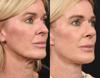
Before and after six weeks post-op
The Emotional Math of a Facelift
“You don’t see a bunch of surgeries in the South where I am from,” she says. “My mother never would have done this in a thousand years, and I think she has aged beautifully, but I was always thinking I would have it done at some point. After seeing my colleague’s results, I thought, what exactly am I waiting for?”
Even so, the decision took months. She had fears. Guilt. The uneasy feeling that elective surgery can still trigger in even the most self-possessed women. “I was terrified to go under anesthesia for multiple hours, because I have children, 10 and 13, and if something happened to me over a cosmetic choice or selfish decision that would have been terrible,” she says. “I am also the money maker in my family, so they would have had financial troubles.”
Her parents had concerns about how it would affect her appearance—and so did Alvarez. She worried about looking too altered, too obviously done. “I didn’t want to look like Kenny Rogers,” she says. “Even celebrities who have things done can look too plastic or cat-like.”
Then there was the money. “There is no credit here,” she says. “It took a lot of effort to put that money away.”
In the week before surgery, she prepared with the diligence of someone training for an aesthetic marathon. She got medical clearance, ate carefully, avoided alcohol and blood-thinning medications, and made sure to dye her hair before the operation because she had been told she would not be able to touch the grays for weeks.
“There is a laundry list of things they advise you to do—and not to do—to set you up for success,” she says.
What a Modern Facelift Really Involves
Alvarez’s surgery lasted nearly 10 hours.
When she woke up, she says, it “felt like a minute.” She opted not to recover at home but instead checked into Pearl Wellness Center, a post-operative care facility near the surgical center, where a 24-hour nursing staff administered ice, ointments, eye drops, antibiotics, pills, and nasal sprays on schedule. “I loved the fact that I didn’t have to think about anything,” she says.
Some doctors advise avoiding mirrors altogether in the first few days following a facelift. But Alvarez couldn’t resist.
“When you first look in the mirror, it’s a lot,” she says. “There were bandages, stitches, drains, and a lot of swelling. I thought, I hope I did the right thing.” Her jaw looked especially prominent. “I had this Jay Leno chin, and I was afraid it was going to stay that way.”
She also had to get used to a version of herself she did not particularly enjoy: being dependent. Her boyfriend of two years, Chad, slept on a cot at the post-care facility the first weekend after surgery, helping her brush her teeth, tie her shoes, and steady herself in the bathroom.
“When I came out of surgery, Chad was almost afraid of me,” she says. “The dried blood in my hair wasn’t pretty, and it was actually a lot for him to see me with all the bandages because he thought I was in pain, even though I wasn’t.”
By day four, a staffer drove her back to Azizzadeh’s office to have tension sutures and a drain removed. At one week, the remaining stitches came out. By day ten, she was back at work in a mask, still swollen and bruised around the neck but looking, to her colleagues, much less battered than they had expected.
Three weeks out, she was thrilled. “My eyes are wide open. The hooding is gone, and you can really see that they are blue again,” she says. “I also have these cheekbones that I have never seen. They are awesome, like I used a highlighter. My chin is chiseled, and I no longer have bunched-up skin. And I don’t look like a different person. People say I look like me, just ten years younger.”
What she’s describing is the new ideal: restoration, not transformation.
“Years ago, everyone could tell if someone had work done,” Azizzadeh says. “Results look more authentic and natural now, so you may never know. We are using the tools we have now to expand our youth span. Surgery doesn’t have to be the first resort, but it doesn’t have to be the last resort either.”
Which may all be true. Just remember: if you start early enough, you are not so much beating time as entering into a long-term administrative relationship with it.
Not Yet Ready to Go Under the Knife? Start Here.
 goop Beauty20% Vitamin C + Hyaluronic Acid Glow Serum$125.00shop now
Anyone serious about skin health should be using vitamin C every morning. It is one of the few topicals with a real track record for helping defend against the daily oxidative stress that contributes to dullness, discoloration, and collagen breakdown over time. This formula uses 20 percent L-ascorbic acid—the purest, most active form of vitamin C—and a unique two-part design you mix yourself, which helps keep it potent in a category where oxidation is a constant problem. Three molecular weights of hyaluronic acid help keep skin hydrated, plump, and comfortable, too.
 goop BeautyYouth-Boost Peptide Serum$150.00shop now
If vitamin C is the nonnegotiable morning antioxidant step, a peptide serum is its perfect sister wife. Unlike retinol—which is best reserved for night and generally shouldn’t be layered with vitamin C in the same routine—peptides are easy to use in the morning and help support the skin in a completely different way: by targeting the early structural changes that show up as fine lines, crepiness, and subtle loss of firmness. The secret sauce is in the formulation: A concentrated peptide targets wrinkles and crepiness, while ceramides, bifidus postbiotics, and safflower oleosomes support barrier repair; paracress and astaxanthin-rich microalgae help with firmness; and niacinamide and black tea ferment boost radiance and even tone.
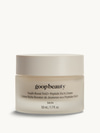 goop BeautyYouth-Boost NAD+ Peptide Rich Cream$105.00shop now
Think of this as the richest, hardest-working step in the routine. It’s designed to pair with the peptide serum, using NMN—a precursor to NAD+—alongside biomimetic plant peptides, postbiotics, and ceramides to support cellular energy, firmness, barrier function, and skin resilience all at once. That matters because aging skin is not just drier; it is slower to repair, thinner, and more reactive. In a third-party clinical study, 100 percent of participants showed increased hydration after one use, and after four weeks, 100 percent showed improved firmness.
 SupergoopMineral Unseen Sunscreen SPF 40$40.00shop now
If you are doing vitamin C, peptides, retinol, and devices and not wearing sunscreen every morning, you are basically sabotaging your own face. This one is especially good because it gives you mineral protection without the usual punishment: zinc oxide and titanium dioxide shield against UVA and UVB rays, antioxidant bamboo extract adds an extra layer of defense, and the featherlight texture disappears into skin with a soft, natural finish. It also doubles as a primer, which makes daily compliance a lot easier.
 goop Beauty3x Retinol Regenerative Serum$150.00shop now
If morning is about protection, night is where the real repair work begins—and retinol is still the gold standard. This formula is especially smart because it uses three different retinoids: Granactive Retinoid for immediate action, plus encapsulated pure retinol and retinal that release over time, helping speed cell turnover and support collagen with less irritation. It also has niacinamide, ceramide NP, a collagen-supporting plant peptide, and soothing licorice extract and bisabolol, so it treats skin without torching your barrier.
 LYMALYMA Laser PRO$5995.00shop now
If you’re not ready for a surgical lift but want to do something more targeted than skin care alone, this is where devices start to get interesting. Unlike LED, LYMA uses low-level near-infrared laser therapy—also known as photobiomodulation—to stimulate cellular repair, support collagen, reduce inflammation, and improve circulation without heat or downtime. The new PRO version uses three 500mW lasers and a much larger treatment lens, so it covers more ground, faster. The catch is that it only works if you actually use it: hold it over each area for three minutes a day, and be patient.