
Hands are the long-suffering mothers of the body. They open jars, hold phones, wash dishes, and send texts we may or may not regret. In return, we mostly ignore them. We will inject a forehead, lift a lash, sculpt a jawline, and apply seven separate products before bed, but the hands are lucky if they get whatever moisturizer is left on our palms. Eventually, they get tired. The cushion underneath starts to recede. The veins become more visible. The skin looks thinner, more wrinkled, and less even.
Looking at my own hands recently, I had the delayed but unmistakable thought: I may owe them an apology. Hoping to make up for years of neglect—or at least understand the damage—I asked facial plastic surgeon Julius Few, MD, what actually happens as hands age, what can be prevented, and what is worth doing once moisturizer is no longer enough.
A Q&A WITH JULIUS FEW, MD
Amy Synnott: Why do hands tend to age so visibly compared with the face? I would guess part of it is lack of care: We do so much to intervene with our faces, and our hands are almost never hidden under clothing.
Julius Few, MD: I think it starts with the anatomy. There’s very little fatty support on the backs of the hands relative to other parts of the body. As that changes and the skin's elasticity changes, it becomes more obvious.
Also, people tend to ignore the look of their hands. They’ll want their faces to be super smooth, and then the minute they rest their hand on a table, you can tell how old they are.
Often, hands will look even older than the person really is. And part of the reason this is so timely is the wild explosion of GLP-1s.
AS: You never really think about hands losing weight. It’s such a strange concept—almost like “Ozempic hands.”
JF: Exactly. And that’s really what I’m seeing with increasing prominence now that we’re in the GLP-1 reality: loss of elasticity in the skin, but also loss of collagen and fatty support under the backs of the hands.
AS: How does the skin on the hands compare with the skin on the neck or face?
JF: The skin on the hand is actually thicker than the skin on the neck. It’s similar to the thickness of skin on other parts of the body, like the arms. The backs of our hands are exposed to the environment, so there’s a natural need for protection there. The thickest skin is actually on the palm of the hand.
The things that tend to manifest cosmetically on the backs of the hands are more prominent veins and wrinkled-looking skin. When you can see the veins much more commonly, they almost look separate from the skin, like they’re coming off the skin. Those are the two things people tend to associate with older-looking hands: prominent veins and wrinkling.
AS: What is the biggest mistake people make when it comes to taking care of their hands?
JF: The biggest mistake is thinking it’s just skin. People try to treat a wrinkle on the back of the hand the way they would treat a wrinkle on the face. But you can’t just laser it away.
You have to look at restoring lost volume first and then the laser second. There is a right sequence to this kind of work. You don’t want the skin to tighten when it doesn’t have adequate support underneath, because then the veins can suddenly appear even more prominent.
So that’s the biggest mistake: using a laser when it’s really a volume issue.
“The biggest mistake is thinking it’s just skin. People try to treat a wrinkle on the back of the hand the way they would treat a wrinkle on the face. But you can’t just laser it away.”
AS: What should a basic daily hand-care routine look like? And at what age should people start?
JF: Everybody forgets to put sunscreen on the backs of their hands, and that’s a huge factor. That’s the first thing.
The second thing is not to be afraid to use a weaker retinol form with a moisturizer at night on the hands.
AS: So basically, as part of your nightly routine, include your hands. But how do you know what counts as a weaker form of retinol?
JF: What I usually recommend is mixing a facial retinol with a rich hand moisturizer.
AS: Does it have to be a hand moisturizer?
JF: No, but you want something thicker. A heavier cream. Shea butter, for example, or something that provides more barrier support.
I don’t think a 25-year-old needs to be doing this, and I don’t want to send that message. This is more part of a rejuvenation strategy. If someone is older, on a GLP-1, or noticing age-related changes in the hands, that’s when these at-home treatments make sense. That’s where the retinol with a thicker moisturizer comes in.
AS: But sunscreen is different. Everyone should be doing that, even from a young age?
JF: Everybody. If you’re outside, at the beach, in the summer, it’s an easy thing to do, and it’s an easy thing people ignore.
The At-Home Hand Edit


AS: Are there specific ingredients you like for hands? You mentioned retinol. What about vitamin C, peptides, and growth factors?
JF: I normally lean heavily on sun protection and retinols. I don’t want to recommend so many things that it becomes hard to manage. That said, if somebody has a lot of irregular pigment on the backs of their hands, vitamin C could be beneficial, because vitamin C can be quite helpful for pigment.
AS: What can actually improve crepey texture or thinning-looking skin on the hands?
JF: The thing I love—and this is probably where fillers don’t get a bad name—is hyaluronic acid-based filler in the hands.
The reason is that these fillers love water. When you place them in the hand, with blood vessels adjacent to the filler, you get a nice plumping effect without making the hand look artificially young or fake. It really becomes a hydration tool.
AS: And this is what you would use for that bony, veiny look?
JF: Yes. The filler is addressing the lost volume. It helps restore support, so the skin doesn’t look so collapsed over the structures underneath.
AS: About how much does it cost to treat both hands with filler?
JF: Everybody is different but starting fees are probably somewhere around $1,500 to $2,000 to treat both hands.
AS: And how long does that last?
JF: I’d say you can get a good year out of it.
AS: Do fillers last that long in the face?
JF: Not as you get closer to the mouth—there, they tend not to last as long, because of movement. But the hands are different. They’re not eating or talking, so the filler tends to just bank there. I have patients who can get a year, a year and a half, sometimes even more.
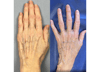
Before and after hand filler
AS: When it comes to brown spots and sun damage on the hands, what works best?
JF: Lasers, for sure. But I always do filler first to set the stage, and then laser second, so you know what you’re really going after.
AS: Are there any newer regenerative treatments—PRP, PRF, biostimulators, exosomes—that you think are promising for hands?
JF: The more interesting thing, in my experience, is using smaller-particle fat as an injectable—nano fat or micro fat.
I don’t tend to do that as a first line, because I want to make sure the patient likes the effect. With a synthetic filler, it’s easy to know. And if someone hated it, you could actually inject the enzyme to melt it. I’ve never had to do that, but theoretically, it has an eraser.
If someone has done the synthetic filler, comes back in a year or a year and a half, likes the effect, and says they want something more long-term, that’s where fat comes in.
AS: So, we’re talking about autologous fat—fat harvested from somewhere else on the body?
JF: Yes.
AS: What about cadaver fat, like the kind we’ve talked about in other procedures?
JF: I don’t have experience using cadaver fat for hands, but I do have a fair amount of experience using a patient’s own fat.
AS: How does the price compare with filler?
JF: Because of operating costs, that will start at a minimum of around $6,000. Depending on what part of the country you’re in, it’s probably in the $6,000 to $10,000 range.
AS: And how long does that last?
JF: Years. It really is years. I’m seeing fat survive for eight years.
AS: Does fat transfer for hands have some of the same downsides as fat transfer elsewhere, where some of the fat might not take?
JF: Exactly. It’s less predictable. You can always adjust or finesse with a second treatment, but that is a disadvantage. You have to harvest it from another part of the body; not all of it will survive, and you also have to be conscious of the idea that you can overdo it.
You don’t want to create a bump, a lump, or fatty-looking hands.
AS: What does overdoing it look like? Like a weird lump in the hand?
JF: Like a growth, if you will. That’s where you have to be careful.
AS: Have you ever seen that happen?
JF: Not in my hands—pun intended.
AS: When would someone consider moving from noninvasive treatments to surgical options? And what, if any, are the surgical options for hands?
JF: As invasive as we get is really what I described with fat. That’s basically the surgical option. People have described doing excisions and similar procedures before lasers. Nobody would do that now.
AS: So, you’re not going to get a “hand lift” or “hand tuck.”
JF: Exactly.
AS: Are there any hand procedures or trends people should be cautious about?
JF: Back probably 25 or 30 years ago, doing hand-vein removal was a thing. I don’t think it’s a thing now, but nothing would surprise me with TikTok and social media.
AS: Just for aesthetic reasons?
JF: For aesthetic reasons.
AS: How do you get blood to your hand without veins?
JF: I know, I know.
AS: In this day and age, with all the looksmaxxing and people walking around with hammers, chipping away at their faces, who knows what people are doing?
JF: That’s what I’m saying. Everybody is trying to find the most sensational thing they can come up with to talk about on social media, and in the current reality, you’re seeing increasingly dramatic efforts to get there.
So, I say this as somebody who’s been doing this for a long time: Don’t ever let anybody talk you into removing veins on your hand.
AS: It sounds like the smartest takeaway is also the most basic one: Start putting sunscreen on your hands in your twenties. Don’t wait until you’re 55 or 60 and suddenly think, Oh, whoops.
JF: It’s the ounce-of-prevention concept. There’s no question.