Tierras Villas in Crete Isn’t Quite a Hotel—and That’s the Point
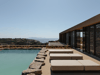
Photo courtesy of Tierras Villas
Long before Tierras Villas, two sisters spent roughly half of each year living with their parents in a single room at the small hotel their family owned and ran on the north coast of Crete. Their parents had the bed; the girls slept on a pullout or in bunks. Their mother braided their hair between taking care of guests at reception, and on Monday nights the girls ran among the tables while their family cooked the weekly barbecue. Hospitality was less a career path than the place where they happened to grow up.
This year, the family opened Tierras Villas, five self-contained houses set into a hillside above the Cretan Sea. The villas have the sheltering quality of caves, but not the gloom. Rough stone runs indoors and out; wooden screens temper the hard Cretan sun; warm marble, raw-wood Shinto chairs, and linen-and-birch loungers keep the rooms spare without making them austere. Each opens through floor-to-ceiling glass onto a broad terrace and 35-foot infinity pool, with a chef’s kitchen and grill for meals at home. It would be easy to spend days here without seeing another guest. But you don’t have to; when you want lunch, Pilates, or access to a gorgeous Byzantine wellness hammam, Acro Suites is just below, perched on a rocky clifftop overlooking Mononaftis Bay.
I stayed in Ryāki, where the long rectangular pool extends toward the edge of the hill, and the rooms open onto shaded terraces. In one bathroom, an enormous amber-colored soaking tub sat directly behind a window facing the pool, a design choice that assumed a certain degree of intimacy among the villa's occupants.

The Ryaki Villa; Sunset at Acro Suites
Fortunately, my friend Katie Ré Scheidt and I had known each other for 20 years—and there were two separate bathrooms.
Katie, an artist, had flown in from Connecticut to meet me. We became close when our children were toddlers, during the years my family spent weekends near hers. There had been backyard dinners, birthday parties, art projects, and a statistically improbable number of glue guns. Life shifted, and we began seeing each other less. Crete was our reunion.
Her flight was delayed the first night, leaving me to eat alone at Caléa, Acro’s more formal restaurant, among couples who appeared to be honeymooning. I seemed to be the only person dining without a romantic partner, a useful piece of information to absorb over eight courses.
David, who introduced himself as the “chef of service,” immediately took charge. Tomato, shrimp, yuzu, and lemon mayonnaise arrived arranged like a rose. Handmade gluten-free bread appeared with olive oil. Lamb came off the charcoal with aubergine cream and avgolemono espuma. I had never had much of a taste for lamb, but this was tender and smoky, with lemon cutting through the richness.
I told David it was the best lamb I had ever eaten.
He looked deeply satisfied, as though lamb had been unfairly maligned and he had personally cleared its name.
When he learned Katie’s flight had been delayed, he offered to put together a few cold plates and sandwiches and deliver them to the villa himself. I told him repeatedly that none of this was necessary.
“It’s not a problem,” he said.
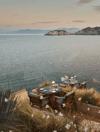
Caléa restaurant
A few hours later, Katie was sitting at our table in Ryāki, eating tomatoes, burrata, and tuna while we engaged in the compressed exchange of information that happens when an old friend arrives after a long absence. Within half an hour, we were swapping notes on surprise Amazon scores, the indignities of menopause butt, and what it felt like to almost be empty nesters. Neither of us was taking it particularly well.
The next morning, I was awake at six, still not entirely on Greek time. I sat beside the pool and watched the light move across the Aegean and the dry hills below the villa. The pale stone turned pink. Then the sun cleared the far edge of the infinity pool, a hard orange disk, and for a moment the water, the sea, and the sky seemed to occupy the same plane. The sunrise was happening not in front of me but around me.
By the time Katie came outside, breakfast had arrived in a large woven basket. David had personally carried it onto the terrace and unpacked eggs, avocado, local preserves, thick yogurt, homemade granola, pomegranate juice, and fresh orange juice with the pulp still in it. There were two kinds of local honey—one still inside a honeycomb—and more varieties of bread than we could finish. We ate beside the pool without seeing another guest.
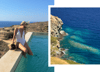
Amy at the Ryaki Villa pool; The view of Mononaftis Bay from the infinity pool at Acro Suites in Agia Pelagia
The following morning, we went down to Acro for Reformer Pilates. Neither of us had done it before. The machine looked like something invented by a person with strong opinions about abdominal weakness, but the instructor was gentle. Beyond the machines, a tall arched window framed sun-baked Cretan hills, their slopes covered in low Mediterranean scrub. I really enjoyed the class, though it was difficult to become overly invested in whether my hips were properly aligned as I was eager to get out to the pool, which we had gotten a brief view of on the way in.
After the class, we showered and went to Cremnos for grilled octopus with charred edges, a tuna Niçoise with jammy eggs, and Cretan wine. When we finished, we moved a few steps from our table to one of the pool’s shaded pavilions, set along the edge of the cliff. Katie and I read and talked while the water below shifted from turquoise near the shore to a deep, saturated blue farther out. Below us, waves broke against the rocks; behind us, cicadas pulsed in the dry hills, growing louder with the heat until conversation required effort.
That evening we ate in an olive grove at Eleonas, where a long table accumulated dishes faster than we could make progress on them: anchovies on crostini, meatballs in tomato and pepper sauce, dense carob bread, octopus with trahanas, little pies filled with greens and local cheese, bowls of fava and tzatziki, followed eventually by lamb and sea bass.
Every dish seemed to come with a story. Olive oil led to the ancient games. Wine led to the Minoans. Avgolemono inevitably led to somebody’s grandmother.
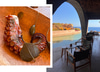
Grilled octopus; Cremnos restaurant
Back at the villa, Katie and I washed our faces and put on our red-light masks. Before leaving for Greece, we had discussed packing them with the seriousness other travelers reserve for prescription medication.
“Are you bringing your red light?” Katie had asked.
“Of course.”
“Okay. I packed mine.”
She eventually fell asleep wearing hers while we watched John Mulaney on my computer, her face glowing red in the darkened villa. I took a picture, mostly because friendship at this age consists partly of accumulating material to embarrass each other later.
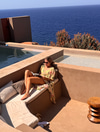
The following day, I sat beside the pool at Momi Slow Living, the hotel where it all began, with the sisters. Their father, Yanni, wandered over and joined us, speaking mostly in Greek while his daughters translated. He talked about Tierras and the work that had gone into making the villas appear so simple.
I asked what “slow living” meant to him.
“No need to rush.”
He said this as though it were a perfectly reasonable way to organize a life. In Los Angeles, “no need to rush” generally means I will get back to you tomorrow. Here, it did not sound like branding. It sounded like a family rule.
On our last morning, Katie went to yoga while I took my first tennis lesson in nearly 30 years down at Acro Suites. After a 60-minute “grounding massage ritual” in the Byzantine Hamman, we then headed to the cliffside infinity pool. With the exception of snapping a few photos and turning the pages of our books, neither of us moved for hours.
No need to rush, apparently.
For once, I took it literally.